March 3, 2013
 Mobile World Congress 2013 is over and some 72.000 visitors and 1.700 exhibiting companies have gone home. The new location – Fira Gran Via – was more “professional” and space, logistics, food, etc was better. But on the other hand, it is far away from down town Barcelona which made people spend much more time in the traffic. And at a couple of occasions the traffic turned really bad.
I have obviously not seen everything and met everyone so my conclusions have no trace of science:
The over-all impression was quite boring rather then exciting. Devices, boxes, antennas and software architectures all over the place and the devices really look the same. Is this a sign of commoditization? The very serious fact that Europe is seriously behind in LTE usage (4% of subscribers world-wide acc. to GSA) should make a lot of Europeans nervous. Our entrepreneurs in the European mobile industry might start move to the US like IT entrepreneurs have done for many years.
The value of MWC continues to be the interaction between people from the same industry across the world why parties and sub-events continue to be important. The 5:th Swedish Mobile Association-party on Monday was spectacular again and my job as bouncer was as easy as all previous years.
There is a growing number of visitors and exhibitors from other industries mainly due to M2M. I guess there were 20 more or less connected cars to look at but I also found exhibitors like Assa Abloy with their connected locks in a small both. I believe this increased focus on what to use the mobile network for is a good development – maybe the event should be divided in two: building and operating networks – using networks.
M2M was everywhere but the heavily promoted GSMA Connected City part of the event I unfortunately found quite dull. In the far end of Hall 3, few visitors, a lot of screens with presentations and no real energy or “heat” (if we exclude the Gangnam Style dancers from KT). And I couldn’t find anything about OTA provisioning of SIMs which was demonstrated by GSMA last year. Connected cars was clearly the most discussed topic in M2M followed by mHealth. I believe it is a sound development that focus on M2M itself disappears (no customer has ever asked me for M2M) and that we start discuss real problems with real customers. The industry needs to be able to create value for the huge SMB market and not only the multi-nationals, consumers and governments. That is the key challenge for M2M today.
Ericsson’s Key Note event Tuesday night was a highlight: well structured and executed with M2M and Networked Society as a leading theme. And finally Vestberg invited Avicii on stage and then they launched a new song right there, XYOU based on a crowd-sourcing process. The thing I really liked was that they showed the Twitter feed from when Avicii entered the stage and when they played the new song we could see it spreading over the Internet on another huge screen. Well thought through and executed! I’m not sure everyone in the audience understood what was going on but my 17 years old daughter was really impressed already by the SMS I sent her.
My choice of coolest product at the show was also in the Ericsson hall. Under the banner “Windows of Opportunities” they demonstrated four connected windows solving real problems. My favorite was the one for skyscrapers which generates electricity from light coming in. I hope they have solid patents in place!
Personally my highlight of the week was outside of MWC. I was invited by Prof. Aninyda Ghosh, assistant professor of entrepreneurship at the great IESE Business School, to give a speech on Parallel Entrepreneurship. I enjoyed every minute!
 Leave a Comment » |
  Consumer market, Healthcare, Inspiring example, M2M, Transportation, User Interaction | Tagged: Anindya Gosh, apps, Assa Abloy, Avicii, B3CC, B3IT, connected city, eCall, Ericsson, IESE, Internet of Things, IT, LTE, M2M, Machine-to-Machine, Mobile World Congress, mwc, OTA, SIM, SMA, Vestberg, Windows of opportunities, xyou |
  Permalink
 Posted by magnusmelander
February 19, 2013
 M2M Service Enablement is the “magic” turning generic communication services into specific applications in an affordable and scalable way. Users need applications addressing their needs and the role of M2M Service Enablers is to make it easier, faster and cheaper to develop, implement and maintain such applications. But M2M Service Enablement is complex and requires communication and IT skills together with serious understanding of the industry or function to serve. Service Enablers need to be specialized since only the companies understanding the context of the data can deliver to the customers according to their expectations. “Connecting things and gather data in the cloud” is already too generic.
The Service Enablement market will be specialized and industry focused. But still it has to become international for M2M to really take off. Today the M2M Device Connectivity part of it is quite international but most Specialist Service Enablers are domestic. And while Device Connectivity solutions enable operators to deliver better and more granular services, Specialist Service Enablers are needed to bring new customers.
In order to try push Service Enablement to become international I started a small alliance called Swedish M2M Service Enablers a year ago. Today two new members joined and we are now ten companies. But we also announced four new sponsors of our initiative, are mobile operators. This gives us more weight and power which is needed to move the internationalization forward.
The purpose of the alliance is to educate the market, promote Sweden as a great place to go to for Service Enablement solutions and to promote the individual members abroad. We welcome invites to collaborate, discuss, speak and most importantly make business together. A number of such relationships are already in place but we can manage many more. Just keep them coming! Next opportunity is to ask for me in the Swedish Pavilion at Mobile World Congress, hall 7 (stand 7E80).
Leave a Comment » | Business Models, Cloud computing, M2M, M2M Service Enablers | Tagged: B3CC, B3IT, Business model, Internet of Things, IoT, M2M, SMSE | Permalink
Posted by magnusmelander
February 13, 2013
 The power of M2M is the ability to enable drastic changes in an industry. To do things differently. To change the game. Like in the early days of Internet we still focus on connecting things. That is good and makes us faster, cheaper, greener, etc. But it doesn’t change the game. It is when the technology is used to completely re-think and re-design something the power is released.
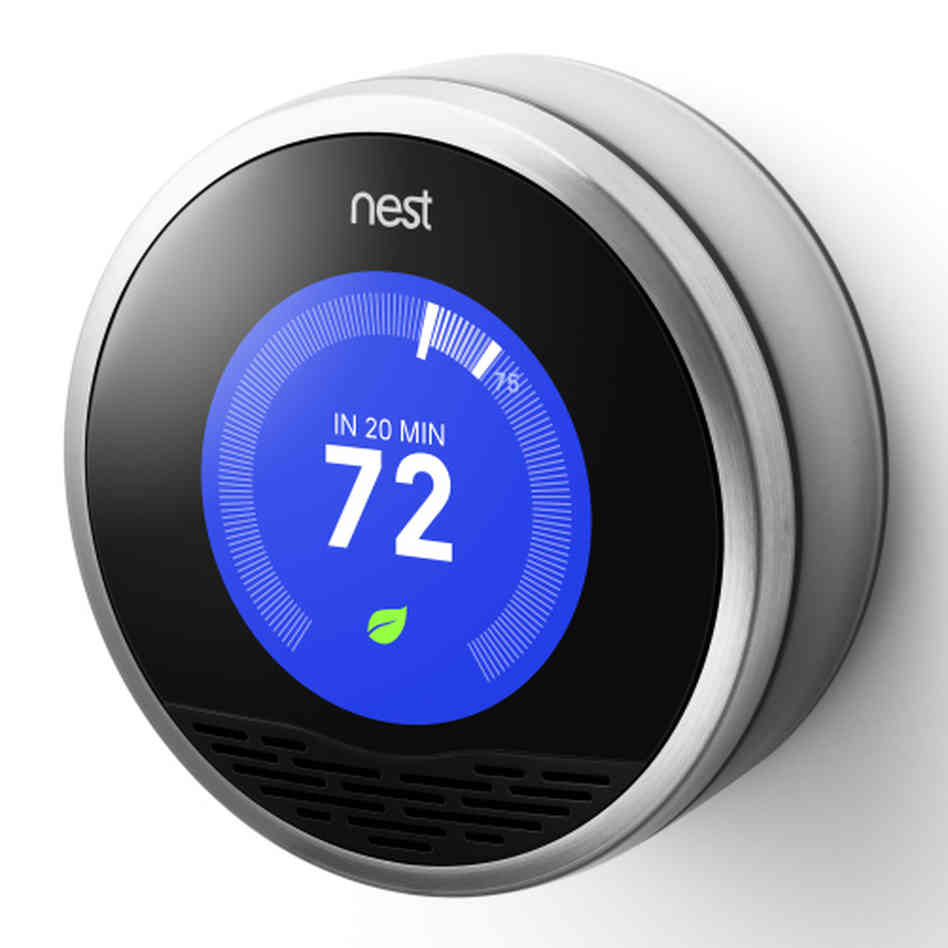
A wonderful example is thermostats. The “father of the iPod”, Tony Fadell, created the “learning thermostat” after having stumbled over expensive, dumb and ugly thermostats for the green house he was building. He created the gorgeously designed Nest which has been shipping for more than a year now. It is said to be compatible with 95% of the American and Canadian low voltage residential heating and cooling market by now. This little sexy device can remove some 20% of the heating and cooling energy bill and cost $250 US. Nest is now shipping 40-50K units per months and investors continue betting on Nest which now is said to be valued to $800 million US.
People normally don’t bother about thermostats but this easy to install and use, wonderfully designed and intelligent darling that saves people money has become a best-seller at Amazon, at Lowe’s and on Apple’s online store. It uses a number of sensors to understand the life-style of the household and adjusts heating and cooling in an optimal way. Beyond the information on the device itself it communicates with people’s smartphones and pads.
Innovative new approaches in established industries are always challenged by established players and Nest is already involved in legal battles. But I think we only have seen the beginning of Nest. Now they address consumers right away, seducing them with design and a good cause. But the device is Wi-Fi and ZigBee enabled thus ready for the Utilities and the Smart Grids. Is there a reason for a Utility to install another device in a home where a Nest already is in place?
1 Comment | Consumer market, Inspiring example, M2M, User Interaction, Utilities | Tagged: Amazon, Apple online store, B3CC, B3IT, cooling, design, energy bill, heating, Internet of Things, IoT, Lowe's, M2M, pads, smartphone, thermostat, usability, Wi-Fi, ZigBee | Permalink
Posted by magnusmelander
December 27, 2012
 The key to rapid progress and growth in the M2M market is Service Enablement. It is the middle-ware, the magic, between generic connectivity and the specific applications the customers are asking for. The Service Enablement has to be robust, secure and efficient in order to make the solutions affordable to develop and maintain. It is also important for the communication provider’s M2M business to scale nicely. Beyond technical matters Service Enablement also has to cover practical issues like deployment and support.
There are three ways to deploy service enablement: in-house, by mobile operator or by independent service enablers. The in-house option is most often used when the data from the connected devices are business-critical which is typically the case when companies provide their product as services. The independent Service Enablers typically place their services on top of the connectivity and provide the entire customized solution for the customer and the devices connected. And mobile operators are increasingly adding a quite generic piece of Service Enablement on top of their connectivity services, dealing with things like alarms, device management, self-service portals and more granular invoicing. This is often referred to as Device Connectivity services which is a natural way for mobile operators to make their M2M offering richer and more competitive.
The Service Enablement part of the market has developed rapidly over the last year with several operators announcing agreements with primarily Jasper Wireless and Ericsson. But we also have a lot of independent Service Enablers active in the M2M market. These independents are most often small national players with scarce resources and difficulties to reach out. We started Swedish M2M Service Enablers (swedishm2m.se) last spring to join forces educating the market and promoting the members. Today we are eight members in the alliance with more in line. But still the operator offerings are too generic for most customers and the indies don’t have muscles enough why customer uptake remain quite slow.
I believe we have to be more granular when talking about Service Enablement in order to get to a solution which is good enough to develop and maintain specific customer applications on. In Beecham’s most recent SES study they identified 22 different service groups and 112 individual service elements within those so M2M Service Enablement is clearly a complex issue. It is already clear that independent Service Enablers must be at least industry focused. It is simply too easy today to just connect terminals and gather the data in the cloud. A competitive service need to understand the data and what to do with it. In other words, Service Enablers have to become Specialist Service Enablers to survive and that is rapidly happening now. With generic Device Connectivity solutions providing standardized APIs for the Specialist Service Enablers to use, the indies can focus all their resources on their speciality. And the operators with such solution in place would be far more attractive to customers and their software developers and integrators to work with. Provided I am right and the market will develop in this direction it might be a dead-end for operators to develop Device Connectivity in-house.
Leave a Comment » | Business Models, M2M, M2M Service Enablers | Tagged: API, B3CC, B3IT, Business model, Device Connectivity, EDCP, Ericsson, independents, indies, Integrator, Internet of Things, Jasper Wireless, M2M, Machine-to-Machine, magic, SMSE, Software developer, Specialist service enabler | Permalink
Posted by magnusmelander
December 2, 2012
 Parking is a critical component of Intelligent Transportation Systems (ITS). Parking space is a scarce and expensive resource in urban environments and every free parking slot is an opportunity to improve the traffic situation and increase efficiency in people’s lives. So far parking space have been a dumb static resource and people’s traveling plans have been based on hope. There are estimates that 30% of city traffic is people looking for parking. The result is wasted fuel and time, excess carbon emissions, frustrated drivers and negative impact on the local economy.
The parking related problems will continue to grow as urban population is growing. We need to act now to establish the parking infrastructure needed to enable development of user-friendly and powerful tools which people can use to plan their traveling properly, owners of parking space can use to optimize their business and service and cities can use to plan their traffic system based on solid data.
At B3IT we developed a concept for dynamic parking which we announced at the ITS World Congress in Vienna in October 2012. It is based on an holistic approach where users get access to information from all organizations involved in parking in a city but where each of these organizations still use a solution to connect and manage their parking space which they prefer. We call this dynamIQ parking™.
Last week we launched dynamIQ parking™ at the Mobile Future conference in Stockholm together with the mobile operator Tele2 and Streetline, the world leader in Smart Parking. The parking issue is incredibly complex with a lot of stake holders, business models, political interests and point of views. I am absolutely convinced it takes a complete solution including a set price in order to move forward. Together with our partners we now have what it takes to offer clients a complete customized solution as a service with a set price. We always start with a six months trial period to a fixed price giving us time to follow-up an adjust the solution for optimal value to the customer. It takes less than two months from signing to have the installation up and running. In other words, this is something very easy for customers to understand and buy and if they aren’t happy after six months they can just abandon the ship. And regardless if the customer is a city, a parking company, a real estate owner, a public transportation company or a private parking space owner they can use our solution to run their parking business better. And the relevant parking data is being made available to drivers together with data from all other parking players simply making urban life easier.
With dynamIQ parking™ in place you can check if there is a decently priced parking available where you are going tomorrow at noon and if you like, reserve and pay for it. And if you don’t find one decide to use public transportation instead. Drivers can use their smartphones, pads and computers but dynamic parking information can also be made available using digital signs and interactive kiosks.
Smart cities simply need dynamIQ parking™!
Leave a Comment » | ITS, M2M, Transportation, User Interaction | Tagged: B3CC, B3IT, dynamIQ parking™, Internet of Things, ITS World Congress, M2M, Mobile Future, parking, Smart City, smart parking, Streetline, Tele2, Traffic, Transportation, User interaction | Permalink
Posted by magnusmelander
October 11, 2012
 Services Enablement is the magic that turns generic communication into specific M2M applications and as such absolutely key to a positive development of M2M. In order to educate the market about the importance of Services Enablement and to promote Swedish Services Enablers I initiated Swedish M2M Services Enablers – SMSE – in March 2012. With the most recent additions we are now eight companies in the alliance.
The Mobile Future conference followed by Mobilgalan award dinner is the key mobile industry event in Sweden since many years and includes the most prestigious mobile awards ceremony. Yesterday the organizers of the event, Mobil and Mobil Business, announced nominations to the
Guldmobilen (Golden Mobile) awards 2012. M2M was introduced as a new category for 2012 which underlines the importance of M2M to the mobile industry and progress in market penetration. Four of the five nominated companies in the M2M category are members of the SMSE alliance which clearly communicate the importance of Services Enablement for the M2M market to develop well. This is all very good news and a concrete evidence of progress. Please join me congratulating
Maingate, Kombridge, Info24 and Springworks for their nominations!
Leave a Comment » | M2M, M2M Service Enablers | Tagged: Awards, B3CC, B3IT, Guldmobilen, Info24, Internet of Things, IoT, Kombridge, M2M, Machine-to-Machine, Maingate, Mediaprovider, Mobil, Mobil Business, Mobil Future, Mobilgalan, Services Enablers, SMSE, Springworks | Permalink
Posted by magnusmelander
October 8, 2012
 We connected businesses and people to the Internet to get mail and web. That was an easy sell! We got it and we discovered a lot of more important things to use the Internet for, increasing productivity and efficiency in organizations across the globe tremendously. Then, clever people started to utilize the data created to invent new applications and business models. Google, Amazon, eBay and Facebook are just a couple of well-known examples. Since nobody had a clue about what the Internet would bring, ignorance was often an acceptable reason for failure at the time.
Now we are connecting also things to the Internet. Once again we focus on connectivity and operational values. Efficiency, Security, Sustainability and Convenience are the key values that M2M and the Internet of Things offer. Soon we will start to see clever people utilize the data created to invent new applications and business models. Well, some have already started. We have seen the movie before and the early warning systems works perfectly well this time why ignorance will not be an acceptable excuse.
It’s about time for decision makers to get on top of the M2M development and what it can do to their organization and industry. There are many ways to find information including articles, blogs, conferences and reports (I obviously recommend M2M Business Strategy & Planning which I am the proud author of) but the important thing is to get going, now.
Leave a Comment » | Business Models, M2M | Tagged: Amazon, B3CC, B3IT, Business model, business models, convenience, decision maker, early warning systems, eBay, efficiency, Facebook, Google, increasing productivity, Internet of Things, IoT, M2M, Machine-to-Machine, security, sustainability | Permalink
Posted by magnusmelander
October 3, 2012
 The magic between the generic communication services and the specific application providing desired value to the users business is what we call M2M Services Enablement. This component of a M2M solution is absolutely vital since it shortens time and effort to develop the solution and minimize the effort to maintain and further develop the solution. The more robust and complete the Services Enablers become, the more users will decide to use M2M solutions. Services can be applied in three different ways: communication providers can add it on top of the connectivity, owners of the connected things can run Services Enablement in-house and one can use an independent third-party.
From a pure technical point of view Services Enablement platforms are generic but the successful providers of these services will be very focused on a specific niche or industry. If we look at a straight forward consumer solution like sleep monitoring, there are several solutions available. But one day there will be a market leader and that solution will definitely include some kind of intelligence applied on the information gathered in the cloud. It could typically be world-class sleep experts who can look at your data and give advice or comparisons to relevant indexes. With such services available it will be difficult to sell a plain stand-alone sleep monitoring solution. What is done with the information collected will differ from industry to industry but the logic will still be the same: players in an industry will benefit from using the Services Enabler who can add most value to their business and they will most likely end up using the same one. Following this logic there will be a large number of Services Enablers each focused on a specific industry, application or niche. The marked development for Services Enablers seems likely to follow Geoffrey Moore’s theories about “crossing the chasm”. Targeting a specific pin in bowling alley is the way to cross the chasm. When on the other side, it’s possible to target another pin, using the first pin as reference.
I continue develop the Swedish M2M Service Enablers (SMSE) alliance and we just included two more companies: Springworks and Episcope. They both follow the logic above and focus on the Automotive industry and Process Industry respectively. I continue to believe that M2M Services Enablement will be a forte for Swedish start-ups.
1 Comment | Cloud computing, M2M, M2M Service Enablers | Tagged: apps, B3CC, B3IT, chasm, crossing the chasm, Episcope, Geoffrey Moore, Internet of Things, M2M, Machine-to-Machine, SMSE, Springworks, Swedish start-ups, Traffic | Permalink
Posted by magnusmelander
September 17, 2012
 The recent announcement from AT&T that they will shut down their 2G network latest year-end 2016 has been discussed a lot lately. It is safe to say that mobile operators in developed markets will continue transitioning their handset users and networks towards 3G and 3G LTE. But mobile operators in general have a growing number of M2M terminals in their networks and they know that over 90% of them are using 2G modules today. Many of them are recently deployed and expected to run without intervention for maybe another five to ten years. Going there, changing SIM, terminal or in worst case the entire device is a very costly thing to do. This is probably why mobile operators in general don’t talk about when they plan to terminate their 2G networks. And I don’t think we will see many announcements like the AT&T one for the next few years, especially not in Europe. Also, let us not forget that many operators in developing countries only have 2G so it will definitely be around for quite some time.
Over the air provisioning of SIM-cards will solve some of the 2G sunset problems but if you need another module in your terminal it will obviously not help. One or two operators in a market, or why not an MVNO, can gather all the 2G terminals and continue service them until the bitter end. The remaining operators would lose some clients but free themselves to go wild on 3 and 4G.
More and more new M2M solutions are using 3G and 3G LTE now. This is natural especially when applications are data rich and require low latency. At Qualcomm IQ last week in Berlin, Steve Mollenkopf, President & COO Qualcomm, stated that one million new 3G connections are added each day. Most of them are not M2M but it means that 3G network capacity and coverage is rapidly improved around the world. And modules and components are coming down in price as volumes grow. And even 3G LTE is spreading. According to Global mobile Suppliers Association (GSA) 96 operators have launched commercial LTE services in 46 countries so far. But the recent announcement of iPhone 5 reminds of the fragmented frequencies of 3G LTE which needs to be taken into account when looking at a specific M2M 3G LTE solution. 3G LTE uses frequencies between 698 MHz – 3800 MHz, divided in 25 bands for FDD (Frequency division duplex) and 11 bands for TDD (Time division duplex).
Leave a Comment » | M2M, Networks | Tagged: 2G, 3G, 3G lte, 4G, AT&T, B3CC, B3IT, Berlin, FDD, GSA, Internet of Things, latency, LTE, M2M, modules, Mollenkopf, MVNO, OTA, over-the-air, Qualcomm, Qualcomm IQ, SIM, TDD | Permalink
Posted by magnusmelander
September 8, 2012
 The key deliverables of M2M are efficiency, security and sustainability. M2M can also deliver convenience which mainly is relevant for the people involved. Well designed M2M implementations often deliver across all of these areas.
Public bus transportation is an important part of the transportation system. To pick the bus should be safe, energy-smart and help improve efficiency in the city. And except for peak hours when buses might be full, the ride should be convenient. But even though buses are quite similar the drivers have different driving style. A recent study at the University of Lund concludes that it is more dangerous to go by bus than by car in cities. Injuries from traffic accidents with buses are rare but a lot of people hurt themselves when they fall during the ride, when jumping on or off the bus or at the bus stop. This is one area where the driver makes a difference. Energy consumption, impact on traffic flow and convenience for the passengers are other areas where the bus drivers knowledge and style makes difference.
The public bus company in the city of Borås in Sweden are now installing a M2M system in the buses which measures how well the drivers drive. The metric used is passenger comfort and a lamp indicates performance: red means poor, yellow is ok and green is great.
I like this a lot since it’s an easy way to improve something in many different ways. Just by showing the performance the drivers will improve their driving – it is an old truth that what is measured gets better. The project makes the company and it’s employees aligned to what is considered important. And last but not least, the “red drivers” get training and the “green drivers” a bonus. What a wonderful way to make things better.
Leave a Comment » | Inspiring example, ITS, M2M, Safety and Security, Transportation, User Interaction | Tagged: B3CC, B3IT, Borås, bus driver, bus stop, convenience, eco driving, efficiency, Internet of Things, M2M, Machine-to-Machine, passenger comfort, public bus, safety, security, sustainability, Traffic, Transportation, transportation system, University of Lund, User interaction | Permalink
Posted by magnusmelander
 Mobile World Congress 2013 is over and some 72.000 visitors and 1.700 exhibiting companies have gone home. The new location – Fira Gran Via – was more “professional” and space, logistics, food, etc was better. But on the other hand, it is far away from down town Barcelona which made people spend much more time in the traffic. And at a couple of occasions the traffic turned really bad.





 connectcompute