June 29, 2013
 What more does it take to make M2M aka Internet of Things – everything or some things – happen big way? Let’s revisit the key components again. Data is the gold of M2M and the winners will be those who best utilize the data captured. Integration of data in existing business systems and processes is key to maximizing the value. Distribution of information through relevant channels and to terminals of users choice, using open api’s and gorgeous human-machine interaction is required for the applications to be used. Generic Device Control platforms on top of service providers networks together with Specialist Service Enablers are required to make it affordable to develop and maintain applications for clients of all types. The winners in Service Enablement will be the ones who understand the data they are dealing with and due to the huge amounts of industries and functions to be served Service Enablement will be a very fragmented part of our industry.
I see most of this happening now and our industry is definitely developing fast. We are in the teenage stage already with clients moving from thinking and talking to doing. From Powerpoint to pilots. There is absolutely no better way to understand what happens if one connects things than actually connecting some things to play around with. And there is no better way to go for that than to contact a Specialist Service Enabler who has most things ready. Connecting things and collecting the data in the cloud was good enough 1-2 years ago when technology was the key challenge. But today the challenges are mainly business centric why understanding the context of the data is key to succeed. This is why Specialist Service Enablers is the right choice when it is time for a pilot or proof of concept project.
But there is one major thing missing: Internet is global, ICT is a global business and Internet of Things will have to be global as well to prosper. Vendors and operators are working quite hard to make this happen which is great but it will take long time and they can’t make it themselves. Most organizations in the world are small to medium-sized and the software they use are mostly local or localized. Law, policies, culture, language, taxonomy, habits, taxation, religion, alphabet and friendship are examples of things that make people use local software. And it will continue to be like this for many many years. Since the data captured in M2M solutions should end up in business applications, maybe blended with data from public or commercial sources, we need what I call a glocal value chain. The global component is needed to drive economies of scale and enable international business etc. The local part is there to cope with the local requirements, to ensure proper integration in business systems and to engage integrators, consultants and developers locally bringing their clients with them.
Glocal value chains are always difficult to make work. But in our case, whatever we call our industry, I find it quite straight forward. The global part consists of operators (like Telenor Connexion) and their alliances (like GMA), Telecommunication vendors (like Ericsson and Telit) and international ICT vendors (like Cisco, SAP and Oracle who all have started to move now). Ever since Ericsson’s 50 Billion Devices statement this inside-out effort has been coming along quite well. The local part, i.e. developers, integrators, resellers and consultants, has in most parts not got going yet and therefore the small to medium businesses in general are in waiting mode or not even aware. Specialist Service Enablers constitute the missing link. Due to missing operator device connectivity services they have had to learn to deal with the connectivity layer directly. And the services they provide to customers in the industry they target is to a large degree useful across boarders. To me it’s clear: operator networks with device connectivity services together with Specialist Service Enablers interfacing to local developers and integrators is the way forward. The challenges are primarily commercial and practical, not technical. I am working with members of Swedish M2M Service Enablers in several projects along those lines and it looks very promising.
 Leave a Comment » |
  Business Models, Cloud computing, M2M, M2M Service Enablers, User Interaction | Tagged: B3IT, Business model, Cisco, consultants, culture, developers, Ericsson, Global M2M Alliance, GMA, integrators, Internet of Things, IoT, language, law, M2M, Machine-to-Machine, open api, Oracle, PoC, SAP, SMSE, taxonomy, Telenor Connexion, telit, User interaction |
  Permalink
 Posted by magnusmelander
June 15, 2013
 An M2M Industry in its teens is a reality. Decision makers are beginning to looking into threats and opportunities with M2M / IoT, and especially product owners are moving to real-life trials and action. I have still to come across a trial which didn’t bring unexpected results and insight! Therefore I keep on arguing that people should leave Excel and Powerpoint behind for a while, and make a trial. Just connect five-ten devices and see what comes out. My favorite example is Springworks who always work very thoroughly and connected their boss’ car and made it tweet to the employees.
If trials and action is the right approach at this stage of M2M, then the value of Service Enablement is even more obvious. If you can find yourself a company who already have built the basics of what you need (i.e. the connectivity part, a cloud based context-aware data service and distribution capabilities through apps, web and maybe other interfaces), who understand your application and are willing to help you getting going fast – just do it! For little money and effort you will get fantastic data in almost no time.
This is why I established Swedish M2M Service Enablers (SMSE) in March 2012. Our objectives are educating the market, promote Sweden as a good place to look for M2M Service Enablement and to promote the alliance members. As of yesterday we added two new members – Fridat and Vinnter – and now we are 12 members and 5 sponsors including TeliaSonera, Telenor Connexion, Tele2 and Net1.
Now when decision makers and product owners want to start doing things the M2M industry runs the risk of loosing them since it is very hard to know where to go to get help. Their existing IT and technology partners will not be able to help and quick small trials are not really what the operators and the consulting firms are keen on. This is where the specialized M2M Service Enablers come in. They will help the industry picking up the interest and turn it into small affordable good enough quality trials. We have presented this pitch at events, meetings and in articles internationally over the last 15 months and we sense momentum building up. Service Enablers from other countries want to join us (and we work with some informally) and we are increasingly asked to come for events and customer meetings, even bilateral efforts.
Swedish M2M Service Enablers (SMSE) is an informal small alliance of companies sharing the desire to be part of building the connected society, Internet of Things, Internet of Everything or whatever we want to call it. They all work really hard in a tough immature market and their creativity and determination to make it happen is fantastic. And there are similar fighters around the world of equal importance to the success of the industry. In my mind they are the key to a successful Internet of Things and I would welcome any initiative that would make life easier for them. Our next big effort is on Tuesday when we run M2M For Real™ 2013 in Stockholm, sharing eleven inspiring real-life M2M-cases with a large number of decision makers. Please keep your ideas, proposals and invitations coming!
Leave a Comment » | Cloud computing, Inspiring example, M2M, M2M Service Enablers | Tagged: B3IT, Internet of Things, M2M, M2M For Real™, Machine-to-Machine, Net1, pilot, SMSE, Springworks, Tele2, Telenor Connexion, TeliaSonera, trial | Permalink
Posted by magnusmelander
May 27, 2013
 Many of us are convinced that M2M, Internet of Things or whatever we want to call it, will happen big ways and will bring massive change to most industries. The part of it easiest to measure is things connected using a mobile subscription and it grows with some 30% per annum. Good growth but from small numbers. Since standard mobile subscriptions sometimes are used to connect things it’s hard to say exactly how many mobile M2M connections we have but it should be close to 150M. And an absolute majority of these are 2G – probably still around 90%.
150M subscriptions is a lot and annual growth 30% normally sends sales directors on President Club trips to Hawaii. But there are a two issues I would like bring attention to.
A big part of the subscriptions comes from connected meters. Connected meters are great and enables smart metering, smart grids, new services, etc. But most of the meters are connected due to political decisions and not business decisions. I called the combination of regulation and public stimulation packages for “M2M doping” at a speech at M2M+ in Milan earlier in May which triggered an interesting discussion. Personally I believe the political push for smart meters around the world is very good for the society and obviously for the M2M industry too. My point is that people in the M2M industry must remember that a big chunk of M2M business so far comes from artificial promotion and not genuine market demand. I believe meters would have become smart also without the doping but it would have taken much longer time. Let’s not fool ourselves!
The next wave of doping is eCall and similar public initiatives. The idea to save lives and minimize injuries due to car accidents by sending an SMS with position when the airbag explodes is over ten years old. Me and my colleagues at BrainHeart Capital invested in Wireless Car at the time together with Volvo, Telia and others, and OnStar was developed in parallel by GM and others in the US. It looked very promising until the owners of the connected cars with the airbag service had to start pay for the service themselves. Very few did and Wireless Car and OnStar, both still live and kicking, had to go after adjacent business opportunities. I’m not saying it’s wrong now when politicians are pushing this to the market, I just want to remind everyone in our industry that this is “doping” and not the result of genuine market forces. Interestingly enough the car industry is very active in Telematics again, with visions and plans often quite similar to the first wave of plans ten-fifteen years ago. But due to the technical approach chosen for eCall these plans might be separated from implementation of eCall. Transport is supposed to be the biggest segment for M2M 2013 and it will be interesting to see if the “built-in approach” will beat the “BYOD-approach” that won last time.
Mobile operators have taken the lead in promoting M2M. All operators want to exploit the expected growth of subscriptions but most if not all of them are uncertain of exactly which role to play. The fact that the M2M business still is a tiny fraction of the operator’s business together with the widespread uncertainty of which role to play could make operators become less aggressive and take on a more cautious “wait-and-see” approach. I definitely don’t vote in favor for such approach and suggest more concrete collaboration with selected partners to conquer industry by industry. Specialist service enablers are key to such efforts and in a perfect world operator device connectivity platforms should be delivered with an á la carte menu of specialist service enablers for different industries. But until that happens I have to continue introducing the members of Swedish M2M Service Enablers to mobile operators one by one.
Leave a Comment » | M2M, M2M Service Enablers, Transportation, Utilities | Tagged: 2G, B3IT, BrainHeart, BYOD, eCall, GM, Internet of Things, M2M, On Call, OnStar, regulation, smart grid, smart meter, SMSE, Telia, Transportation, Volvo, Wireless Car | Permalink
Posted by magnusmelander
May 13, 2013
 Digital documents are cheaper, faster and environmentally better to deal with than paper documents and they can be automatically dealt with in applications of all sorts. The Internet enabled swift distribution of digital documents and PC’s with scanners became a normal way to digitalize paper documents in offices and homes. Scanning companies introduced large scale scanning services and the smartphones enabled mobile scanning by use of the embedded camera and distribution over the mobile network or Wi-Fi. But one important need has not yet been fulfilled: secure mobile digitalization.
Many business documents are critical for completion of processes – a signed delivery note is needed for invoicing, a signed bank note for completion of a transaction, a signed agreement for completion of a deal and a signed prescription to acquire serious medicine in a drug store. Such documents need to be taken care of with relevant security.
Possio’s new Mobile Scan to Email Service addresses the need to digitalize a paper document on the go and send it securely to pre-defined receivers. These documents are typically sent via traditional mail, courier or fax today but in many cases collected and brought manually to the office. Regardless of method it often adds many days or even weeks to processes. In some cases the documents can’t be read or never even arrives. If and when the paper document arrives it often has to be scanned into a digital document for further processing. Imagine scanning the document when it is signed, sending it safely over the mobile network to a pre-defined receiver with acknowledgement that delivery went fine and in a minute have it delivered to the right person anywhere in the world. The receiver doesn’t have to digitalize the document before next action and due to rich metadata attached to each document they become traceable. One can even use the keyboard for authentication of the person sending the document.
Possio Mobile Scan to Email Service is an easy to use cloud based service with scanners attached via mobile networks. A customer is defined in the cloud based server and can add or remove scanners as desired. Each customer decide the functionality of their own private service, i.e. which email addresses should receive documents, if keypads should be used to send documents to different receivers and if authentication should be used. Customers buy the terminals and pay a fixed monthly fee for the service. Possio currently offers two terminals: Possio GRETA Mobile Scanner and Printer which is a mobile all-in-one A4-scanner terminal and Possio SVEA GSM Connector which deliver the Mobile Scan to Email Service using any standard G3 fax.
Secure Mobile Digitalization can speed up and increase quality of business processes across most industries. Typical applications are “internal mail substitution” and management of delivery documentation. It is generically true that the earlier in the business process a paper document can be digitalized and securely transferred the better.
I am personally involved in Possio and believe this is a good example of a generic M2M application meeting real operational needs of businesses around the world. The patent pending technology also enables mobile operators to transition from mobile fax problems to secure mobile digitalization opportunities. It will be interesting to see how the new service is received at M2M+ and M2M Forum in Milan today and tomorrow. I’m here with a delegation from Swedish M2M Service Enablers: Springworks, Maingate, Possio and B3IT.
Leave a Comment » | Cloud computing, Inspiring example, M2M | Tagged: authentication, B3CC, B3IT, bank, bd consult, business process, delivery note, digital document, fax, G3, GPRS, GRETA, GSM connector, healthcare, Internet of Things, invoicing, M2M, M2M Forum, Maingate, mobil scan, mobile digitalization, paper document, Possio, prescription, S2E, scan, scan to email, secure, Springworks, SVEA, Transportation | Permalink
Posted by magnusmelander
April 13, 2013
 Initially technical innovators focus all they have on making it do whatever they want their innovation to do. Shortly after the breaking news about their brand new product, solution or service we use to receive the follow-on news about problems with things like security, health impact, integrity or fair trade. The scope of the problems obviously relates to what the new thing actually is.
Lets face it, it has always been like this. Telephone systems, microwave ovens, TV set-top boxes, ATM:s, door locks, PCs and Wi-Fi networks are all examples of things that quite easily were possible to manipulate, at least initially. But when we connected people and businesses to the Internet the magnitude of the problem increased many times. Having almost everything using the same communication protocols and even the same network gained us a lot of efficiency but also raised the security bets drastically. Most attacks are not reported publicly but the ones we hear about are serious enough. Fire Eye claims one security attack to enterprises every third second, based on analysis of information on more than 89 million security related attacks reported. Some specific examples since last summer, picked up from Network World: 450.000 stolen passwords from Yahoo, 5,8 million passwords from LinkedIn, 1,5 million from eHarmony, 8 million online credentials from Gamigo and about 3.6 million Social Security numbers and 387,000 credit and debit card numbers from South Carolina. And we all remember the series of password thefts at Sony some two years ago. We’re already at the point where this belongs to the daily news feed and is business as usual.
Now we are connecting also things to the Internet and we will inevitably enter a new era of security and integrity issues, yet on another scale. Imagine hackers manipulating traffic lights, road signs, railroad control systems, power grids, nuclear plants, TV broadcasts, elections, pacemakers, airplanes, stock exchanges or hospitals. Media is quite frequently presenting examples along those lines and even if it is hard to differ between urban legends and real life cases it is safe to say that security will be a very important part of the M2M industry.
Recent examples from media include the Techspot.com story about a security consultant and pilot who claims he can hijack a commercial airplane remotely with his Android app, a story about a hacked pacemaker in the US where almost five million pacemakers and implantable defibrillators have been sold the last five years and several stories about hacked cars including the most recent research from Rutger University and University of South Carolina where they manipulated cars in motion via the TPMS system. At the Hack in the Box conference in Amsterdam the other day electrical vehicle charging stations were identified as potential targets for hackers to cripple parts of the electricity grid.
If the issues of security, safety and integrity aren’t taken seriously by the industry they will slow down or even prevent deployment of M2M solutions. Since perception is reality we need to go beyond just fixing the issue – we also have to make people believe it is taken care of seriously.
Leave a Comment » | M2M, Safety and Security | Tagged: ATM, B3CC, B3IT, eHarmony, fair trade, Fire Eye, Gamigo, Health, Internet of Things, LinkedIn, M2M, Network World, pacemaker, PC, security, Sony, South Carolina, techspot, Wi-Fi, Yahoo | Permalink
Posted by magnusmelander
April 8, 2013
 2013 is the year when M2M aka Internet of Things entered the productivity phase which I have been writing about before. Focus moves from the actual connection to what value comes out. The value we look at in this phase is typically operational thus quantifiable and ROI-calculation friendly. In the next phase, probably as little as 1-2 years away, we will start harvest also the strategic value and that is when industries and society will change drastically.
Already a couple of month into “the year of M2M productivity” I can share a great Swedish example: STF Ingenjörsutbildning is a postgraduate education institute targeting engineers and technicians. They run some 2000 training activities per annum with 15000 attendees, mainly in Sweden but also abroad. STF just announced a one day training on “M2M – from products to services” aiming at providing practical guidance to the attendees. Where to start? Who to turn to? Legal implications? Purchasing considerations? Pitfalls? Hopefully the attendees will have information and confidence enough to start their first in-house project when they come home.
I have been quite involved in this training and believe this is a very important step forward for the industry. We simply need to make people understand the value of M2M for them and give them knowledge enough to start playing around with ideas, prototypes and trials. It is simply not possible to figure out before hand what will happen and which new opportunities we will have when we connect our products. This to me is a great way to drive technology driven innovation.
Leave a Comment » | Business Models, M2M | Tagged: B3CC, B3IT, Business model, Internet of Things, M2M, prototype, SMSE, STF, STF Ingenjörsutbildning, training, trial | Permalink
Posted by magnusmelander
April 5, 2013
The M2M industry is rapidly leaving the first connectivity focused baby phase – thank god! – and enters the productivity phase. This is where we look at operational issues, capabilities and value. Vendors and operators are preparing themselves to be able to serve the market better and more efficiently. And new partnerships, alliances, initiatives and M&A activities pop up on a daily basis. This is all very good and makes life easier for developers, integrators and customers. But it is more about preparing for the business to take off than making it taking off. It mainly improves the capabilities to deliver in an efficient way.
Today’s initiatives are signs of a developing industry. Building blocks are put together into candidate platforms and architectures. As always most of them will fail over time but still it is an important part of growing up. Let’s look at a couple of recent M2M “teenager activities”:
- Telefónica and Telit cooperate in M2M Air, providing managed M2M services globally
- Etisalat group just joined KPN, NTT DOCOMO, Rogers Communications, SingTel, Telefonica, Telstra and VimpelCom in the M2M Multi-Operator Alliance
- Ericsson and SAP announced a partnership at MWC and talk about the M2M Eco-system
- Satellite operator Orbcomm acquired MobileNet who provides custom mobile data solutions for the heavy equipment and railroad industries
- Wipro and Axeda announced a strategic alliance to provide services and end-to-end solutions to help organizations connect with any asset, leverage machine data to enhance business processes and develop new innovative enterprise applications.
- TeliaSonera, France Telecom-Orange and Deutsche Telekom collaborate to increase the quality of service and interoperability for machine-to-machine (M2M) communications
- Claro Brazil joins a growing list of Jasper Wireless operator partners including AT&T, América Móvil, NTT DOCOMO, Telefónica, VimpelCom, KPN, SingTel, Etisalat, Telstra, Rogers, CSL and more
- Several operators including TeliaSonera, Swisscom, XL and have signed up with Ericsson to use DCP for improved M2M service delivery
- AT&T has several M2M initiatives including AT&T Control Center together with partners like Jasper Wireless, Axeda, Sierra Wireless and SensorLogic.
- Airbiquity and China Unicom are teaming up to provide telematics services for the Chinese automotive market
- Vodafone Vehicle Connect and Towers Watson’s ‘DriveAbility’ programme will accelerate the pace at which insurers can get new services to market, and at a competitive cost
Looking at mobile operator subscriptions for M2M, the market continues to grow roughly 25-30% per annum. The number of cellular M2M subscriptions nearly doubled between 2010 and 2012 to reach 143.7 million according to Pyramid Research. They also claim China is growing over 40% per annum and will become the largest cellular M2M market this year. We should remember that a lot of M2M applications share cellular subscriptions or use other technologies to connect.
So operator’s M2M business is growing quite rapidly but from small numbers. In a fairly well-developed M2M market like Sweden, M2M subscriptions are roughly 20% of all mobile subscriptions today. But still most of the market potential is untouched. Policy-driven markets like smart meters, big global markets like connected cars and consumer oriented stand-alone solutions are all fairly well addressed. But small business is big business also when it comes to M2M, and these companies are only addressed by independent Service Enablers, developers, integrators and turn-key solution providers. The alliances, partnerships and M&A activities aren’t reaching that far. A company connecting 100 of their “things” per year in maybe 25 countries across the globe is simply of no interest to any of the large players. The same goes for ,a company who want to develop a specific application to connect 25 of their “things” in a country, unless they are filthy rich.
Success in SME will come from successful platform support for specialist service enablers, developers, integrators and turn-key solution providers. That has little to do with technical issues and a lot to do with trust and business models. This has to be resolved before M2M will grow up.
Leave a Comment » | Business Models, M2M, M2M Service Enablers | Tagged: America Movil, AT&T, Axeda, B3CC, B3IT, Business model, Claro Brazil, CSL, Deutche Telekom, Eco-system, Ericsson, Etisalat, France Telecom, Internet of Things, Jasper, KPN, M2M, M2M Air, M2M Multi-Operator Alliance, MobileNet, NTT DOCOMO, Orange, Orbcomm, Rogers, SAP, SensorLogic, Sierra wireless, SingTel, SMSE, Swisscom, Telefonica, TeliaSonera, telit, Telstra, VimpelCom, Wipro, XL | Permalink
Posted by magnusmelander
March 15, 2013
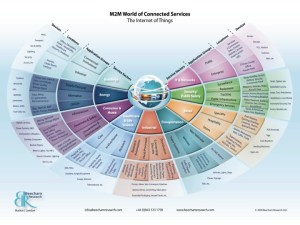 M2M is not a solution. It is a way to segment the market: are we connecting a business, person or a thing to the Internet? The actual connection is of less importance to users – it is what it enables that makes sense. And the data created makes even more sense. We have seen the movie before – when people and business were connected to the Internet we started focusing on the connection. Then we discovered enormous benefits when processes became much more efficient. And finally innovative solutions and business models started change industries upside down. We entered the “as-a-service” era.
Over the last 18 months we have seen a clear change from the 50 billion devices approach to M2M towards a more user oriented approach where a range of M2M solutions are part of the ICT toolbox. If we compare to when Internet arrived we are leaving the connectivity period and enter the enabling user value era. We solve customer problems, we save money, we increase efficiency, we bring cost down or save energy. We create operational value. Previously everyone talked about smart meters and connected vehicles due to the large numbers involved. Now the addressed markets discussed are increasingly granular. The further we go down this road the more critical specialist service enablers become.
Last year the Connected Home pavilion at MWC in Barcelona was an important frequently visited showcase for M2M solutions and M2M was mentioned in most key notes. This year, the Connected City pavilion at MWC was a quite boring and less crowded but in every corner of the show and at every party people discussed what could be done with M2M solutions.
Mobile operators all try to figure out which role to play. Subscriptions alone seem less interesting. Adding device connectivity on top of the network helps deliver a better service. Going after large applications like smart meters, ebooks and connected cars is a no brainer. But how to win and deliver the second and third-tier of opportunities is the thousand dollar question of today. Small business is big business. I am convinced that those who can find a way to collaborate with the specialist service enablers will win. And such collaboration is not a matter of technical integration – it’s all about trust, business models and how to go to market. Our Swedish M2M Service Enablers alliance is always interested in efforts to answer the thousand dollar question of today.
Leave a Comment » | Business Models, M2M, M2M Service Enablers | Tagged: as-a-service, B3CC, B3IT, Business model, connected city, connected home, go-to-market, Internet of Things, M2M, Mobile World Congress, mwc, SMSE | Permalink
Posted by magnusmelander
March 13, 2013
 I had the opportunity to attend a lunch with Kevin Kelly last Thursday. Kevin was co-founder of Wired magazine in January 1993 and served as Executive Editor from September 1992 to January 1999. In 2009 Kevin Launched The Quantified Self movement with Gary Wolf and today there are some 200 QS groups. QS Stockholm was founded in April 2012 and we are 253 members by now. QS is covering all aspects of people’s desire to measure themselves. It’s interesting and fun to explore this area but for me it is more than so: it is a key component of Healthcare 2.0.
People challenge healthcare – There are more of us, we live longer and we have better tools. The results are increasingly constrained healthcare resources and more knowledgable individuals. Our objectives must be drastically improved efficiency and a person-centric healthcare and the way forward is a holistic life-long data-centric approach, leverage of technology and involvement of individuals. Banks were able to outsource many of their tasks to their customers, we shop on the Internet, trade shares and order flight tickets and hotel rooms, so why couldn’t healthcare do something similar?
A person-centric life-long healthcare approach should include wellness, fitness, self-care, healthcare and home care and it is in this context Quantify Self can play a pivotal role. People are already collecting data on themselves, using tools like pen and paper, smartphones, pads and computers. Pew Internet & American Life Project claim 7 in 10 American adults tracks a health indicator like weight, diet, exercise or a symptom. But half say they track “in their heads” and about a fifth use technology. The QS movement can be used as a rich source of innovative self-tracking methods and tools. And it constitutes a great test bench for all kind of real life tests.
Putting easy-to-use tools in the hands of curious people always enable innovation. It is an alternative approach to research which often brings unexpected results. The rewards of progress in the health field are huge regardless if we measure financial savings or increased quality of life. eHealth, mHealth or rather Health is one of the most interesting application areas for M2M solutions.
Leave a Comment » | Healthcare, M2M | Tagged: B3IT, efficiency, eHealth, fitness, Gary Wolf, Health, home care, Internet of Things, Kevin Kelly, M2M, mHealth, pew internet, QS, Quantified self, self-care, wellness, Wired | Permalink
Posted by magnusmelander
March 3, 2013
 Mobile World Congress 2013 is over and some 72.000 visitors and 1.700 exhibiting companies have gone home. The new location – Fira Gran Via – was more “professional” and space, logistics, food, etc was better. But on the other hand, it is far away from down town Barcelona which made people spend much more time in the traffic. And at a couple of occasions the traffic turned really bad.
I have obviously not seen everything and met everyone so my conclusions have no trace of science:
The over-all impression was quite boring rather then exciting. Devices, boxes, antennas and software architectures all over the place and the devices really look the same. Is this a sign of commoditization? The very serious fact that Europe is seriously behind in LTE usage (4% of subscribers world-wide acc. to GSA) should make a lot of Europeans nervous. Our entrepreneurs in the European mobile industry might start move to the US like IT entrepreneurs have done for many years.
The value of MWC continues to be the interaction between people from the same industry across the world why parties and sub-events continue to be important. The 5:th Swedish Mobile Association-party on Monday was spectacular again and my job as bouncer was as easy as all previous years.
There is a growing number of visitors and exhibitors from other industries mainly due to M2M. I guess there were 20 more or less connected cars to look at but I also found exhibitors like Assa Abloy with their connected locks in a small both. I believe this increased focus on what to use the mobile network for is a good development – maybe the event should be divided in two: building and operating networks – using networks.
M2M was everywhere but the heavily promoted GSMA Connected City part of the event I unfortunately found quite dull. In the far end of Hall 3, few visitors, a lot of screens with presentations and no real energy or “heat” (if we exclude the Gangnam Style dancers from KT). And I couldn’t find anything about OTA provisioning of SIMs which was demonstrated by GSMA last year. Connected cars was clearly the most discussed topic in M2M followed by mHealth. I believe it is a sound development that focus on M2M itself disappears (no customer has ever asked me for M2M) and that we start discuss real problems with real customers. The industry needs to be able to create value for the huge SMB market and not only the multi-nationals, consumers and governments. That is the key challenge for M2M today.
Ericsson’s Key Note event Tuesday night was a highlight: well structured and executed with M2M and Networked Society as a leading theme. And finally Vestberg invited Avicii on stage and then they launched a new song right there, XYOU based on a crowd-sourcing process. The thing I really liked was that they showed the Twitter feed from when Avicii entered the stage and when they played the new song we could see it spreading over the Internet on another huge screen. Well thought through and executed! I’m not sure everyone in the audience understood what was going on but my 17 years old daughter was really impressed already by the SMS I sent her.
My choice of coolest product at the show was also in the Ericsson hall. Under the banner “Windows of Opportunities” they demonstrated four connected windows solving real problems. My favorite was the one for skyscrapers which generates electricity from light coming in. I hope they have solid patents in place!
Personally my highlight of the week was outside of MWC. I was invited by Prof. Aninyda Ghosh, assistant professor of entrepreneurship at the great IESE Business School, to give a speech on Parallel Entrepreneurship. I enjoyed every minute!
Leave a Comment » | Consumer market, Healthcare, Inspiring example, M2M, Transportation, User Interaction | Tagged: Anindya Gosh, apps, Assa Abloy, Avicii, B3CC, B3IT, connected city, eCall, Ericsson, IESE, Internet of Things, IT, LTE, M2M, Machine-to-Machine, Mobile World Congress, mwc, OTA, SIM, SMA, Vestberg, Windows of opportunities, xyou | Permalink
Posted by magnusmelander
 What more does it take to make M2M aka Internet of Things – everything or some things – happen big way? Let’s revisit the key components again. Data is the gold of M2M and the winners will be those who best utilize the data captured. Integration of data in existing business systems and processes is key to maximizing the value. Distribution of information through relevant channels and to terminals of users choice, using open api’s and gorgeous human-machine interaction is required for the applications to be used. Generic Device Control platforms on top of service providers networks together with Specialist Service Enablers are required to make it affordable to develop and maintain applications for clients of all types. The winners in Service Enablement will be the ones who understand the data they are dealing with and due to the huge amounts of industries and functions to be served Service Enablement will be a very fragmented part of our industry.






 connectcompute