October 30, 2012
 ITS World Congress in Vienna is over. A well organized high-profile event with ministers, a grand opening event and a grand ball. The large exhibition halls were full of technology and complex drawings, the seminar program extensive and ministers from all over the world attended. We have seen the movie before: there was full agreement among delegates, speakers and exhibitors also at the 19:th ITS World Congress that ITS is important to save the world, increase safety and security and improve efficiency for people, organizations and societies. A lot of things are happening in the field but still too many “one road here and one road there pilots”.
But there are three fairly new enablers in the ITS market that can make things happen big way:
- – the smartphones and pads allowing us to visualize complex things and deliver relevant real-time information for powerful decision-making
- – the Open Data initiatives carried out in Europe and elsewhere enabling developers to access enormous amounts of relevant data for innovative ITS solutions
- – the rapidly growing M2M market is feeding Service Enablers with data and together with the Open Data sources this enables faster and more cost efficient development and maintenance of applications.
We have what we need to start taking real advantage of ITS now. Decision makers need to be brave enough to make the right decisions: ensure a strategy for management of data, use of M2M, etc. then go from pilots to action, open up the data and let the entrepreneurs figure out what users want. This will help us realize the benefits of ITS in terms of efficiency, sustainability, security and convenience.
 Leave a Comment » |
  ITS, M2M, M2M Service Enablers, Safety and Security, Transportation | Tagged: B3IT, convenience, ITS World Congress, M2M, Open Data, pads, PSI, security, smartphones, sustainability, Traffic, Transportation, Vienna |
  Permalink
 Posted by magnusmelander
September 8, 2012
 The key deliverables of M2M are efficiency, security and sustainability. M2M can also deliver convenience which mainly is relevant for the people involved. Well designed M2M implementations often deliver across all of these areas.
Public bus transportation is an important part of the transportation system. To pick the bus should be safe, energy-smart and help improve efficiency in the city. And except for peak hours when buses might be full, the ride should be convenient. But even though buses are quite similar the drivers have different driving style. A recent study at the University of Lund concludes that it is more dangerous to go by bus than by car in cities. Injuries from traffic accidents with buses are rare but a lot of people hurt themselves when they fall during the ride, when jumping on or off the bus or at the bus stop. This is one area where the driver makes a difference. Energy consumption, impact on traffic flow and convenience for the passengers are other areas where the bus drivers knowledge and style makes difference.
The public bus company in the city of Borås in Sweden are now installing a M2M system in the buses which measures how well the drivers drive. The metric used is passenger comfort and a lamp indicates performance: red means poor, yellow is ok and green is great.
I like this a lot since it’s an easy way to improve something in many different ways. Just by showing the performance the drivers will improve their driving – it is an old truth that what is measured gets better. The project makes the company and it’s employees aligned to what is considered important. And last but not least, the “red drivers” get training and the “green drivers” a bonus. What a wonderful way to make things better.
Leave a Comment » | Inspiring example, ITS, M2M, Safety and Security, Transportation, User Interaction | Tagged: B3CC, B3IT, Borås, bus driver, bus stop, convenience, eco driving, efficiency, Internet of Things, M2M, Machine-to-Machine, passenger comfort, public bus, safety, security, sustainability, Traffic, Transportation, transportation system, University of Lund, User interaction | Permalink
Posted by magnusmelander
August 17, 2012
 A lot of people and animals are killed and injured in road traffic, road vehicles impact our environment significantly and road traffic is an important part of efficient transportation of people and goods. With the key promises of M2M being safety, sustainability and efficiency there is a perfect match between road traffic and M2M. A lot of research projects are on-going and part of the overall efforts towards the ITS (Intelligent Transportation Systems) vision.
The air traffic system has for many years been developed aiming towards zero accidents. This process has made air traffic very safe and I am told that most of the remaining accidents are caused by human beings. The use of UAV (Unmanned Aerial Vehicle) and UCAV (Unmanned Combat Aerial Vehicle) is increasing mainly to avoid dull, dirty or dangerous flying missions. We have for example all heard about drone attacks (military planes without pilots) in countries like Pakistan and Afghanistan.
If we can fly helicopters and aircrafts without pilots we must be able to modernize the road traffic to make it safer, more friendly to nature and more efficient. And even if humans cause many or maybe most of the problems on the road we still don’t feel comfortable putting ourselves in the hands of technology on the roads or in the air. But this will change. The technical solutions are ahead of what we are willing to accept but carefully managed real life trials together with clear and big benefits will slowly make us humans agree to start using new solutions.
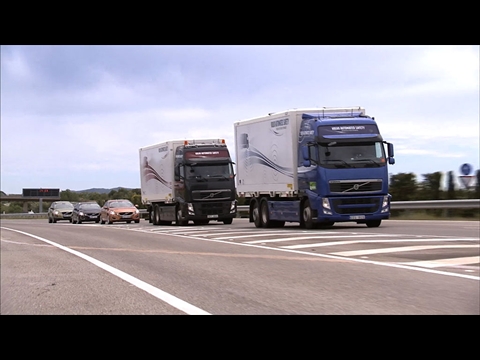
There are many advanced research projects in road traffic continuously pushing the frontier forward. Earlier this summer Volvo successfully led a road train consisting of a Volvo XC60, a Volvo V60 and a Volvo S60 behind a truck on a 200 km journey through Spain as part of SARTRE (Safe Road Trains for Environment). The cars outfitted with cameras, radars and laser sensors were six meters apart and drove safely 85 km/h without any driver interference. The vehicles in the test have covered some 10.000 km on test circuits before the trial. Beyond improved safety and sustainability road trains would allow us drivers to put a professional driver in command for a while, take a bite, check our mail and take a nap before taking control of the car again. Sounds great!Another interesting project is Google Driverless Cars. In May 2012 the first license for a self-driven car was issued in Nevada: a Toyota Prius modified with Google’s experimental driver-less technology. The team just announced that they have completed over 300,000 autonomous-driving miles accident-free, typically have about a dozen cars on the road at any given time, and are starting to test them with single drivers instead of in pairs.
ITS World Congress 2012 in Vienna October 22-26 is an interesting event for anyone interested in where road traffic is going. I’ll be there!
Leave a Comment » | ITS, M2M, Safety and Security, Transportation | Tagged: B3CC, B3IT, driverless, droner, Google, Internet of Things, IoT, ITS World Congress, M2M, Machine-to-Machine, road train, SARTRE, Toyota, Traffic, Transportation, UAV, UCAV, Volvo | Permalink
Posted by magnusmelander
July 3, 2012
The European Parliament just adopted a resolution where they call on the European Commission and Member States to make sure eCall is installed in every new vehicle by 2015. The Parliament consider this resolution a major step towards the roll-out of eCall in Europe that will have a significant impact on citizens’ safety.
This is certainly a good intention and with 35-40.000 Europeans killed and over a million injured in road accidents per year something needs to be done. But it is not obvious that eCall will make a big difference in that regard. Some countries don’t have national response centers which will make implementation more difficult and similar services from car manufacturers haven’t really become commercially popular. I guess the road towards less road traffic accidents starts with better drivers, better cars and better roads but I obviously hope eCall will save a lot of lives.
But connecting all new cars in a similar fashion could potentially make a difference in other ways. If some data would be made more openly available we could see a lot of new innovative services made available to drivers, owners, insurance companies and government agencies. Imagine apps like the Volvo App managing the parking heater etc becoming available for all cars, maintenance data becoming available to third party service companies, real time position data available to ITS systems, etc. And if some of these services really would take off the vehicle M2M retrofit market would be huge. We all know it by now: data is the gold of M2M.
Leave a Comment » | ITS, M2M, Safety and Security, Transportation, User Interaction | Tagged: apps, B3CC, data is the gold of M2M, eCall, European Commission, European Parliament, insurance, Internet of Things, M2M, m2m retrofit, On Call, open api, Traffic, Transportation, Volvo | Permalink
Posted by magnusmelander
June 4, 2012
 ABB acquires the Wi-Fi mesh pioneer Tropos Networks to strengthen its Utility Communications product group. California based Tropos Networks has delivered a large number of wireless metropolitan and campus networks over the last ten years or so and I would even say that they made Wi-Fi mesh a viable metro network solution to the market.
This acquisition by ABB is very interesting and underline the grande potential for especially smart grids but also other private network applications. Tropos has deployed private networks for applications like meter reading, ITS, mobile workforce, public safety, telemedicine, parking meters, etc.
M2M is required to solve the efficiency problems, the security issues and the sustainability challenges in the world. And many of these applications will use private networks for financial and/or security reasons. Each of these areas will develop to become ICT systems in the size of the Internet which is why really large global players invest early on. I suggest you keep an eye at GE, ABB, Siemens, IBM and similar players.
Interesting move ABB!
1 Comment | Healthcare, ITS, M2M, Networks, Safety and Security, Transportation, Utilities | Tagged: ABB, GE, IBM, ICT, M2M, mesh, meter reading, metro networks, parking meters, Private networks, public safety, Siemens, telemedicine, Tropos, WiFi | Permalink
Posted by magnusmelander
 ITS World Congress in Vienna is over. A well organized high-profile event with ministers, a grand opening event and a grand ball. The large exhibition halls were full of technology and complex drawings, the seminar program extensive and ministers from all over the world attended. We have seen the movie before: there was full agreement among delegates, speakers and exhibitors also at the 19:th ITS World Congress that ITS is important to save the world, increase safety and security and improve efficiency for people, organizations and societies. A lot of things are happening in the field but still too many “one road here and one road there pilots”.
 connectcompute