December 11, 2013
 Companies are investing a lot of money year after year to communicate with their customers and influence their perception of their company and brands. The budgets are there basically to sow for future sales and they remain on the same level year after year measured as a percentage of sales. The ever-increasing challenge is the growing number of channels to be used, and the constantly changing relative importance of them. But the best channel by all means has always been the product itself. Customers who buy it has it and use it often for a long time. People around them might see them using it. Satisfied users as well as dissatisfied users are happy to tell others about their experience.
All of this is well-known facts. But what is less known is that it has become realistically possible to establish a continuous dialogue with the products and also the users of them depending of what product it is, by using modern M2M or Internet of Things technology. Examples of products that often are connected already are: trucks, electrical meters, cars, alarms, vending machines and coffee machines. They are typically connected for operational benefits like being able to tell the truck driver to go to a service facility and depending on where he is propose which one, for electricity companies to measure and report consumption almost in real-time, for vending machines to understand when it’s time to go there to fill it up and better schedule the service route, for coffee machine rental companies to change recipes over the air and for alarm companies to get the alarms automatically. This is all fine and the normal first phase of an M2M investment. Operational value is easy to realize and make ROI investments on thus easier to get project approval and budgets for.
As we all know by now: data is the gold of M2M. And with these things connected we can gather and interpret the data from the connected things and start use it to create strategic value. Examples could be that the owner of the truck could measure how drivers actually drive, provide training to them and become a more sustainable company, the electricity company could offer customers better price off-peak hours, vending machines would get decision support from real data to know what products to have on weekends and warm days in different parts of the country and to use dynamic pricing, coffee machine companies could tune the choice of coffee for different seasons and learn customer’s coffee drinking habits and the alarm companies could add new adjacent services to their alarm infrastructure to become more competitive. All these things are examples of how the collected data could be used to add brand value, competitiveness, customer loyalty, innovation and attractiveness for employees, etc.
We are in the teen-age of M2M aka Internet of Things and many companies have started to connect their things, mainly for operational reasons. But it is still very rare to see companies using the data to create strategic value. Most consumer goods is not connected and if it is, there is no organized use of the data collected. Most professional equipment isn’t connected either and if it is, the data is rarely used in an organized fashion to create strategic value.
But this is about to change and I think we will see a lot of new examples in 2014. A number of new relevant ways of connecting things are available including the power-efficient and very small Bluetooth 4.0 chips with innovative solutions like iBeacon, networks optimized for connecting millions of autonomous things like Sigfox and a host of different ways to associate real life things with an avatar on the Internet like QR-codes, smart cameras, RFID and innovative solutions from companies like Evrythng.
This isn’t about technology. It is only when clever strategists, progressive marketing directors, creative advertising agencies, determined product managers and innovative business developers really understand what is practically and financially possible today that true innovation beyond operational value creation starts to happen. Interesting examples of creative customer communication through products could be the Evian Smart Drop, Volvo’s On Call app enabling their B2B+B2C model and Apple’s recent launch of an iBeacon based service in all 254 Apple Stores in the US.
 1 Comment |
  Business Models, Consumer market, Inspiring example, M2M, Markeing, User Interaction | Tagged: apps, Bluetooth, Brand, Evian, Evrythng, iBeacon, Internet of Things, IoT, M2M, Machine-to-Machine, On Call, QR condes, Rfid, Sigfox, smart camera, Smart Drop, Volvo, Wbird |
  Permalink
 Posted by magnusmelander
December 5, 2013
 Data is the gold of M2M! This remains the most important thing to keep in mind when trying to understand where the industry is going. When collecting the data from sensors and sub-systems of all sorts, we need to understand the context in order to turn the data into useful information. Data analysis without understanding the context opens up for poor conclusions and decision-making down the road. No news here! The value of the information created appears when the information is properly integrated into business systems, decision-making systems, etc. No news here either!
The good news is that the need to understand the context for the data collected and the fact that value materialize when the information is integrated into ERP systems, processes and decision-making systems clearly points towards a fragmented market with successful players focused on industries or functions. Good news is that this is how the software industry has been structured for years. And efficiency is achieved by generic platforms, tools and API:s which specialized applications can utilize.
Since M2M will have to become an international business to benefit from scale this brings us a “glocal” value chain like this: customized or specific software provided to customers by local integrators, resellers or consultants working with specialized international M2M Service Enablers. Software used is based on generic platforms, tools and API:s – this is where Oracle, IBM, Microsoft, SAP and others come in. And the M2M Service Enablers are agnostic to devices and connectivity. And sensors are provided by a variety of specialized companies.
Voila!
So which conclusions could we draw? The three most important conclusions to me are that:
- M2M Service Enablers need to be agnostic to connectivity and device
- there are many M2M Service Enablers in each country today and only the ones who are really specialized, context aware, will survive when it becomes an international market
- generic software companies as well as connectivity providers need to figure out how to work with the best M2M Service Enablers
Leave a Comment » | Business Models, M2M, M2M Service Enablers, Networks | Tagged: business system, Decision-making, ERP systems, glocal, IBM, integrators, Internet of Things, IoT, M2M, Machine-to-Machine, Microsoft, open api, Oracle, SAP, sensors, SMSE, value chain | Permalink
Posted by magnusmelander
June 29, 2013
 What more does it take to make M2M aka Internet of Things – everything or some things – happen big way? Let’s revisit the key components again. Data is the gold of M2M and the winners will be those who best utilize the data captured. Integration of data in existing business systems and processes is key to maximizing the value. Distribution of information through relevant channels and to terminals of users choice, using open api’s and gorgeous human-machine interaction is required for the applications to be used. Generic Device Control platforms on top of service providers networks together with Specialist Service Enablers are required to make it affordable to develop and maintain applications for clients of all types. The winners in Service Enablement will be the ones who understand the data they are dealing with and due to the huge amounts of industries and functions to be served Service Enablement will be a very fragmented part of our industry.
I see most of this happening now and our industry is definitely developing fast. We are in the teenage stage already with clients moving from thinking and talking to doing. From Powerpoint to pilots. There is absolutely no better way to understand what happens if one connects things than actually connecting some things to play around with. And there is no better way to go for that than to contact a Specialist Service Enabler who has most things ready. Connecting things and collecting the data in the cloud was good enough 1-2 years ago when technology was the key challenge. But today the challenges are mainly business centric why understanding the context of the data is key to succeed. This is why Specialist Service Enablers is the right choice when it is time for a pilot or proof of concept project.
But there is one major thing missing: Internet is global, ICT is a global business and Internet of Things will have to be global as well to prosper. Vendors and operators are working quite hard to make this happen which is great but it will take long time and they can’t make it themselves. Most organizations in the world are small to medium-sized and the software they use are mostly local or localized. Law, policies, culture, language, taxonomy, habits, taxation, religion, alphabet and friendship are examples of things that make people use local software. And it will continue to be like this for many many years. Since the data captured in M2M solutions should end up in business applications, maybe blended with data from public or commercial sources, we need what I call a glocal value chain. The global component is needed to drive economies of scale and enable international business etc. The local part is there to cope with the local requirements, to ensure proper integration in business systems and to engage integrators, consultants and developers locally bringing their clients with them.
Glocal value chains are always difficult to make work. But in our case, whatever we call our industry, I find it quite straight forward. The global part consists of operators (like Telenor Connexion) and their alliances (like GMA), Telecommunication vendors (like Ericsson and Telit) and international ICT vendors (like Cisco, SAP and Oracle who all have started to move now). Ever since Ericsson’s 50 Billion Devices statement this inside-out effort has been coming along quite well. The local part, i.e. developers, integrators, resellers and consultants, has in most parts not got going yet and therefore the small to medium businesses in general are in waiting mode or not even aware. Specialist Service Enablers constitute the missing link. Due to missing operator device connectivity services they have had to learn to deal with the connectivity layer directly. And the services they provide to customers in the industry they target is to a large degree useful across boarders. To me it’s clear: operator networks with device connectivity services together with Specialist Service Enablers interfacing to local developers and integrators is the way forward. The challenges are primarily commercial and practical, not technical. I am working with members of Swedish M2M Service Enablers in several projects along those lines and it looks very promising.
Leave a Comment » | Business Models, Cloud computing, M2M, M2M Service Enablers, User Interaction | Tagged: B3IT, Business model, Cisco, consultants, culture, developers, Ericsson, Global M2M Alliance, GMA, integrators, Internet of Things, IoT, language, law, M2M, Machine-to-Machine, open api, Oracle, PoC, SAP, SMSE, taxonomy, Telenor Connexion, telit, User interaction | Permalink
Posted by magnusmelander
April 8, 2013
 2013 is the year when M2M aka Internet of Things entered the productivity phase which I have been writing about before. Focus moves from the actual connection to what value comes out. The value we look at in this phase is typically operational thus quantifiable and ROI-calculation friendly. In the next phase, probably as little as 1-2 years away, we will start harvest also the strategic value and that is when industries and society will change drastically.
Already a couple of month into “the year of M2M productivity” I can share a great Swedish example: STF Ingenjörsutbildning is a postgraduate education institute targeting engineers and technicians. They run some 2000 training activities per annum with 15000 attendees, mainly in Sweden but also abroad. STF just announced a one day training on “M2M – from products to services” aiming at providing practical guidance to the attendees. Where to start? Who to turn to? Legal implications? Purchasing considerations? Pitfalls? Hopefully the attendees will have information and confidence enough to start their first in-house project when they come home.
I have been quite involved in this training and believe this is a very important step forward for the industry. We simply need to make people understand the value of M2M for them and give them knowledge enough to start playing around with ideas, prototypes and trials. It is simply not possible to figure out before hand what will happen and which new opportunities we will have when we connect our products. This to me is a great way to drive technology driven innovation.
Leave a Comment » | Business Models, M2M | Tagged: B3CC, B3IT, Business model, Internet of Things, M2M, prototype, SMSE, STF, STF Ingenjörsutbildning, training, trial | Permalink
Posted by magnusmelander
April 5, 2013
The M2M industry is rapidly leaving the first connectivity focused baby phase – thank god! – and enters the productivity phase. This is where we look at operational issues, capabilities and value. Vendors and operators are preparing themselves to be able to serve the market better and more efficiently. And new partnerships, alliances, initiatives and M&A activities pop up on a daily basis. This is all very good and makes life easier for developers, integrators and customers. But it is more about preparing for the business to take off than making it taking off. It mainly improves the capabilities to deliver in an efficient way.
Today’s initiatives are signs of a developing industry. Building blocks are put together into candidate platforms and architectures. As always most of them will fail over time but still it is an important part of growing up. Let’s look at a couple of recent M2M “teenager activities”:
- Telefónica and Telit cooperate in M2M Air, providing managed M2M services globally
- Etisalat group just joined KPN, NTT DOCOMO, Rogers Communications, SingTel, Telefonica, Telstra and VimpelCom in the M2M Multi-Operator Alliance
- Ericsson and SAP announced a partnership at MWC and talk about the M2M Eco-system
- Satellite operator Orbcomm acquired MobileNet who provides custom mobile data solutions for the heavy equipment and railroad industries
- Wipro and Axeda announced a strategic alliance to provide services and end-to-end solutions to help organizations connect with any asset, leverage machine data to enhance business processes and develop new innovative enterprise applications.
- TeliaSonera, France Telecom-Orange and Deutsche Telekom collaborate to increase the quality of service and interoperability for machine-to-machine (M2M) communications
- Claro Brazil joins a growing list of Jasper Wireless operator partners including AT&T, América Móvil, NTT DOCOMO, Telefónica, VimpelCom, KPN, SingTel, Etisalat, Telstra, Rogers, CSL and more
- Several operators including TeliaSonera, Swisscom, XL and have signed up with Ericsson to use DCP for improved M2M service delivery
- AT&T has several M2M initiatives including AT&T Control Center together with partners like Jasper Wireless, Axeda, Sierra Wireless and SensorLogic.
- Airbiquity and China Unicom are teaming up to provide telematics services for the Chinese automotive market
- Vodafone Vehicle Connect and Towers Watson’s ‘DriveAbility’ programme will accelerate the pace at which insurers can get new services to market, and at a competitive cost
Looking at mobile operator subscriptions for M2M, the market continues to grow roughly 25-30% per annum. The number of cellular M2M subscriptions nearly doubled between 2010 and 2012 to reach 143.7 million according to Pyramid Research. They also claim China is growing over 40% per annum and will become the largest cellular M2M market this year. We should remember that a lot of M2M applications share cellular subscriptions or use other technologies to connect.
So operator’s M2M business is growing quite rapidly but from small numbers. In a fairly well-developed M2M market like Sweden, M2M subscriptions are roughly 20% of all mobile subscriptions today. But still most of the market potential is untouched. Policy-driven markets like smart meters, big global markets like connected cars and consumer oriented stand-alone solutions are all fairly well addressed. But small business is big business also when it comes to M2M, and these companies are only addressed by independent Service Enablers, developers, integrators and turn-key solution providers. The alliances, partnerships and M&A activities aren’t reaching that far. A company connecting 100 of their “things” per year in maybe 25 countries across the globe is simply of no interest to any of the large players. The same goes for ,a company who want to develop a specific application to connect 25 of their “things” in a country, unless they are filthy rich.
Success in SME will come from successful platform support for specialist service enablers, developers, integrators and turn-key solution providers. That has little to do with technical issues and a lot to do with trust and business models. This has to be resolved before M2M will grow up.
Leave a Comment » | Business Models, M2M, M2M Service Enablers | Tagged: America Movil, AT&T, Axeda, B3CC, B3IT, Business model, Claro Brazil, CSL, Deutche Telekom, Eco-system, Ericsson, Etisalat, France Telecom, Internet of Things, Jasper, KPN, M2M, M2M Air, M2M Multi-Operator Alliance, MobileNet, NTT DOCOMO, Orange, Orbcomm, Rogers, SAP, SensorLogic, Sierra wireless, SingTel, SMSE, Swisscom, Telefonica, TeliaSonera, telit, Telstra, VimpelCom, Wipro, XL | Permalink
Posted by magnusmelander
March 15, 2013
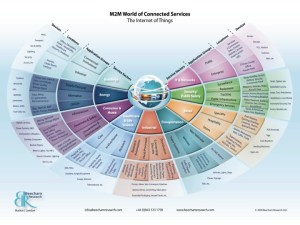 M2M is not a solution. It is a way to segment the market: are we connecting a business, person or a thing to the Internet? The actual connection is of less importance to users – it is what it enables that makes sense. And the data created makes even more sense. We have seen the movie before – when people and business were connected to the Internet we started focusing on the connection. Then we discovered enormous benefits when processes became much more efficient. And finally innovative solutions and business models started change industries upside down. We entered the “as-a-service” era.
Over the last 18 months we have seen a clear change from the 50 billion devices approach to M2M towards a more user oriented approach where a range of M2M solutions are part of the ICT toolbox. If we compare to when Internet arrived we are leaving the connectivity period and enter the enabling user value era. We solve customer problems, we save money, we increase efficiency, we bring cost down or save energy. We create operational value. Previously everyone talked about smart meters and connected vehicles due to the large numbers involved. Now the addressed markets discussed are increasingly granular. The further we go down this road the more critical specialist service enablers become.
Last year the Connected Home pavilion at MWC in Barcelona was an important frequently visited showcase for M2M solutions and M2M was mentioned in most key notes. This year, the Connected City pavilion at MWC was a quite boring and less crowded but in every corner of the show and at every party people discussed what could be done with M2M solutions.
Mobile operators all try to figure out which role to play. Subscriptions alone seem less interesting. Adding device connectivity on top of the network helps deliver a better service. Going after large applications like smart meters, ebooks and connected cars is a no brainer. But how to win and deliver the second and third-tier of opportunities is the thousand dollar question of today. Small business is big business. I am convinced that those who can find a way to collaborate with the specialist service enablers will win. And such collaboration is not a matter of technical integration – it’s all about trust, business models and how to go to market. Our Swedish M2M Service Enablers alliance is always interested in efforts to answer the thousand dollar question of today.
Leave a Comment » | Business Models, M2M, M2M Service Enablers | Tagged: as-a-service, B3CC, B3IT, Business model, connected city, connected home, go-to-market, Internet of Things, M2M, Mobile World Congress, mwc, SMSE | Permalink
Posted by magnusmelander
February 19, 2013
 M2M Service Enablement is the “magic” turning generic communication services into specific applications in an affordable and scalable way. Users need applications addressing their needs and the role of M2M Service Enablers is to make it easier, faster and cheaper to develop, implement and maintain such applications. But M2M Service Enablement is complex and requires communication and IT skills together with serious understanding of the industry or function to serve. Service Enablers need to be specialized since only the companies understanding the context of the data can deliver to the customers according to their expectations. “Connecting things and gather data in the cloud” is already too generic.
The Service Enablement market will be specialized and industry focused. But still it has to become international for M2M to really take off. Today the M2M Device Connectivity part of it is quite international but most Specialist Service Enablers are domestic. And while Device Connectivity solutions enable operators to deliver better and more granular services, Specialist Service Enablers are needed to bring new customers.
In order to try push Service Enablement to become international I started a small alliance called Swedish M2M Service Enablers a year ago. Today two new members joined and we are now ten companies. But we also announced four new sponsors of our initiative, are mobile operators. This gives us more weight and power which is needed to move the internationalization forward.
The purpose of the alliance is to educate the market, promote Sweden as a great place to go to for Service Enablement solutions and to promote the individual members abroad. We welcome invites to collaborate, discuss, speak and most importantly make business together. A number of such relationships are already in place but we can manage many more. Just keep them coming! Next opportunity is to ask for me in the Swedish Pavilion at Mobile World Congress, hall 7 (stand 7E80).
Leave a Comment » | Business Models, Cloud computing, M2M, M2M Service Enablers | Tagged: B3CC, B3IT, Business model, Internet of Things, IoT, M2M, SMSE | Permalink
Posted by magnusmelander
December 27, 2012
 The key to rapid progress and growth in the M2M market is Service Enablement. It is the middle-ware, the magic, between generic connectivity and the specific applications the customers are asking for. The Service Enablement has to be robust, secure and efficient in order to make the solutions affordable to develop and maintain. It is also important for the communication provider’s M2M business to scale nicely. Beyond technical matters Service Enablement also has to cover practical issues like deployment and support.
There are three ways to deploy service enablement: in-house, by mobile operator or by independent service enablers. The in-house option is most often used when the data from the connected devices are business-critical which is typically the case when companies provide their product as services. The independent Service Enablers typically place their services on top of the connectivity and provide the entire customized solution for the customer and the devices connected. And mobile operators are increasingly adding a quite generic piece of Service Enablement on top of their connectivity services, dealing with things like alarms, device management, self-service portals and more granular invoicing. This is often referred to as Device Connectivity services which is a natural way for mobile operators to make their M2M offering richer and more competitive.
The Service Enablement part of the market has developed rapidly over the last year with several operators announcing agreements with primarily Jasper Wireless and Ericsson. But we also have a lot of independent Service Enablers active in the M2M market. These independents are most often small national players with scarce resources and difficulties to reach out. We started Swedish M2M Service Enablers (swedishm2m.se) last spring to join forces educating the market and promoting the members. Today we are eight members in the alliance with more in line. But still the operator offerings are too generic for most customers and the indies don’t have muscles enough why customer uptake remain quite slow.
I believe we have to be more granular when talking about Service Enablement in order to get to a solution which is good enough to develop and maintain specific customer applications on. In Beecham’s most recent SES study they identified 22 different service groups and 112 individual service elements within those so M2M Service Enablement is clearly a complex issue. It is already clear that independent Service Enablers must be at least industry focused. It is simply too easy today to just connect terminals and gather the data in the cloud. A competitive service need to understand the data and what to do with it. In other words, Service Enablers have to become Specialist Service Enablers to survive and that is rapidly happening now. With generic Device Connectivity solutions providing standardized APIs for the Specialist Service Enablers to use, the indies can focus all their resources on their speciality. And the operators with such solution in place would be far more attractive to customers and their software developers and integrators to work with. Provided I am right and the market will develop in this direction it might be a dead-end for operators to develop Device Connectivity in-house.
Leave a Comment » | Business Models, M2M, M2M Service Enablers | Tagged: API, B3CC, B3IT, Business model, Device Connectivity, EDCP, Ericsson, independents, indies, Integrator, Internet of Things, Jasper Wireless, M2M, Machine-to-Machine, magic, SMSE, Software developer, Specialist service enabler | Permalink
Posted by magnusmelander
November 9, 2012
 Intelligent Transport Systems (ITS) has been worked on for some twenty years. The idea to look at traffic and transportation using a holistic approach is great and rarely disputed. And the effects when ready would be fantastic! Efficiency, safety, sustainability and convenience, all the key promises of M2M, are there. But still the development is quite slow. Of course we need to remember that a lot of these issues are infrastructure related thus complex and time-consuming to develop. And a multimodal transportation approach require integrated organizations which is yet another complex thing to change. There are also many stakeholders and a lot of legislation involved.
But still I believe there are ways to drastically speed up the process: by leveraging the rapid development in technology in combination with innovation and pragmatism we could make things happen fast. Examples of key things to leverage are
- the open data movement to allow entrepreneurs to drive innovation
- the smartphones and pads to allow users of the transportation systems to access the information they need to make qualified decisions
- crowd sourcing and other innovative ways to collect data
- entrepreneurs to drive creativity, innovation and choice
A very good example of an ITS type application which is in place and leverage all of these is
Waze. It is
the world’s fastest growing community-based traffic and navigation app and it is free. They claim 30 million users already and they even get help to edit the maps from their users. It started as an open-source mapping project in 2006 and Waze was founded 2008. The company is backed by serious investors and the business model is based on location-based advertising. The level of innovation is high and you can for example connect your Facebook account to see where your friends are.
Think about this: First came GPS devices integrated into cars for maybe 3-5K$, then came mobile GPS devices, often with better maps and features, for about 1/10 of the price and now this, for free. The power of what today’s technology and modern ways of working can do is immense. The services are continuously improved and by using one device for many things we even help save the planet.
I am focusing a lot on ITS and together with our partners and entrepreneurs we have numerous concepts and ideas (including dynamIQ parking™ which we launched at ITS World Congress) leveraging modern technology and ways of working to make drastic ITS progress. Let’s get going!
Leave a Comment » | Business Models, Inspiring example, ITS, M2M, Transportation, User Interaction | Tagged: apps, B3IT, Business model, convenience, crowd sourcing, efficiency, entrepreneurs, GPS, Internet of Things, investor, M2M, Machine-to-Machine, open api, pads, security, smartphone, sustainability, Traffic, Transportation, usability, User interaction, VC, Waze | Permalink
Posted by magnusmelander
October 8, 2012
 We connected businesses and people to the Internet to get mail and web. That was an easy sell! We got it and we discovered a lot of more important things to use the Internet for, increasing productivity and efficiency in organizations across the globe tremendously. Then, clever people started to utilize the data created to invent new applications and business models. Google, Amazon, eBay and Facebook are just a couple of well-known examples. Since nobody had a clue about what the Internet would bring, ignorance was often an acceptable reason for failure at the time.
Now we are connecting also things to the Internet. Once again we focus on connectivity and operational values. Efficiency, Security, Sustainability and Convenience are the key values that M2M and the Internet of Things offer. Soon we will start to see clever people utilize the data created to invent new applications and business models. Well, some have already started. We have seen the movie before and the early warning systems works perfectly well this time why ignorance will not be an acceptable excuse.
It’s about time for decision makers to get on top of the M2M development and what it can do to their organization and industry. There are many ways to find information including articles, blogs, conferences and reports (I obviously recommend M2M Business Strategy & Planning which I am the proud author of) but the important thing is to get going, now.
Leave a Comment » | Business Models, M2M | Tagged: Amazon, B3CC, B3IT, Business model, business models, convenience, decision maker, early warning systems, eBay, efficiency, Facebook, Google, increasing productivity, Internet of Things, IoT, M2M, Machine-to-Machine, security, sustainability | Permalink
Posted by magnusmelander
 Companies are investing a lot of money year after year to communicate with their customers and influence their perception of their company and brands. The budgets are there basically to sow for future sales and they remain on the same level year after year measured as a percentage of sales. The ever-increasing challenge is the growing number of channels to be used, and the constantly changing relative importance of them. But the best channel by all means has always been the product itself. Customers who buy it has it and use it often for a long time. People around them might see them using it. Satisfied users as well as dissatisfied users are happy to tell others about their experience.




 connectcompute