August 17, 2012
 A lot of people and animals are killed and injured in road traffic, road vehicles impact our environment significantly and road traffic is an important part of efficient transportation of people and goods. With the key promises of M2M being safety, sustainability and efficiency there is a perfect match between road traffic and M2M. A lot of research projects are on-going and part of the overall efforts towards the ITS (Intelligent Transportation Systems) vision.
The air traffic system has for many years been developed aiming towards zero accidents. This process has made air traffic very safe and I am told that most of the remaining accidents are caused by human beings. The use of UAV (Unmanned Aerial Vehicle) and UCAV (Unmanned Combat Aerial Vehicle) is increasing mainly to avoid dull, dirty or dangerous flying missions. We have for example all heard about drone attacks (military planes without pilots) in countries like Pakistan and Afghanistan.
If we can fly helicopters and aircrafts without pilots we must be able to modernize the road traffic to make it safer, more friendly to nature and more efficient. And even if humans cause many or maybe most of the problems on the road we still don’t feel comfortable putting ourselves in the hands of technology on the roads or in the air. But this will change. The technical solutions are ahead of what we are willing to accept but carefully managed real life trials together with clear and big benefits will slowly make us humans agree to start using new solutions.
There are many advanced research projects in road traffic continuously pushing the frontier forward. Earlier this summer Volvo successfully led a road train consisting of a Volvo XC60, a Volvo V60 and a Volvo S60 behind a truck on a 200 km journey through Spain as part of SARTRE (Safe Road Trains for Environment). The cars outfitted with cameras, radars and laser sensors were six meters apart and drove safely 85 km/h without any driver interference. The vehicles in the test have covered some 10.000 km on test circuits before the trial. Beyond improved safety and sustainability road trains would allow us drivers to put a professional driver in command for a while, take a bite, check our mail and take a nap before taking control of the car again. Sounds great!Another interesting project is Google Driverless Cars. In May 2012 the first license for a self-driven car was issued in Nevada: a Toyota Prius modified with Google’s experimental driver-less technology. The team just announced that they have completed over 300,000 autonomous-driving miles accident-free, typically have about a dozen cars on the road at any given time, and are starting to test them with single drivers instead of in pairs.
ITS World Congress 2012 in Vienna October 22-26 is an interesting event for anyone interested in where road traffic is going. I’ll be there!
 Leave a Comment » |
  ITS, M2M, Safety and Security, Transportation | Tagged: B3CC, B3IT, driverless, droner, Google, Internet of Things, IoT, ITS World Congress, M2M, Machine-to-Machine, road train, SARTRE, Toyota, Traffic, Transportation, UAV, UCAV, Volvo |
  Permalink
 Posted by magnusmelander
August 8, 2012
 AT&T just announced that they will shut down their 2G network no later then January 1 2017. They want to free up spectrum for mobile Internet network capacity. “Well in advance of this change, we will reach out to our relatively small percentage of 2G customers and offer them options to meet their needs” says a spokesperson to Fierce MobileIT. According to Berg Insight AT&T had 13.1 million M2M subscribers by the end of 2011. It is often stated that the 2G share of the M2M subscriptions are bigger then 90%. I don’t know the AT&T mix but it is likely that at least half of their 13 million subscribers use 2G.
PricewaterhouseCoopers recently made a study and found that 60 percent of wireless operators plan on decommissioning their legacy networks over the next five years. Their study would suggest that more operators would like to make similar announcements as AT&T.
M2M terminals are often expected to be operational 5-10 years which makes the choice of network technology difficult. From a capacity point of view 2G is often enough and 2G modules are cheaper than modules supporting 3G and 4G/LTE. Coverage of the 3G networks are often not as good as the 2G networks. It is far too early for LTE networks to take over. Support for circuit switched connections which are required when moving terminals from the fixed phone networks (PSTN) to mobile networks is only available in 2G. It will be interesting to see what AT&T’s announcement will do to customers, regulators and other mobile operators. And what about countries were mobile networks are all 2G?
I believe this is a challenge for the development of the M2M market. As far as I understand it, AT&T will have to subsidize the remaining 2G M2M customers to replace terminals or loose the customers to other operators. This new situation for ongoing and planned M2M projects might delay or in worst case kill them if the up-front investment becomes substantially bigger. This news also explains why M2M customers need over-the-air provisioned SIMs.
3 Comments | M2M, Networks | Tagged: 2G, 3G, 4G, AT&T, B3CC, B3IT, CSD, Internet of Things, LTE, M2M, PSTN, PwC, SIM | Permalink
Posted by magnusmelander
August 4, 2012
 Single purpose M2M solutions have started to appear in the market. They are typically addressing one specific problem with a combination of hardware, software and communication. If the problem addressed is clear and considered big enough by many people and the solution works well then the willingness to pay should be possible to build a business around. Provided the solution uses the cloud to deliver the service from, then expanding the solution to include generic devices like smartphones, pads and PCs is an interesting next step at least to access the data but maybe to run the entire application on as well.
A good example is Coyote from France who claims over 1.7 million users of their speed camera alert system in Europe. The service is also available as an app for iPhone/iPad, Android, Blackberry and for Parrot. A Coyote device cost about 250€ including one year of service. A solution like this is also interesting for mobile operators since one agreement can sell hundreds of thousands subscriptions of the same type and each deal like this provides opportunities to add service enablement services on top of the connectivity.
The two key success factors of products like these are a high quality solution to a reasonable big problem and ease-of-use out of the box. Then people are willing to pay reasonably well for the service and word of mouth will work for marketing. Easy to buy and use solutions are also interesting in sales channels. It is quite likely that we will see many more single purpose M2M solutions onwards.
Leave a Comment » | Business Models, Cloud computing, Consumer market, M2M, M2M Service Enablers, User Interaction | Tagged: apps, B3CC, B3IT, Business model, Coyote, Internet of Things, IoT, M2M, Machine-to-Machine, speed camera, Traffic, Transportation, usability | Permalink
Posted by magnusmelander
July 3, 2012
The European Parliament just adopted a resolution where they call on the European Commission and Member States to make sure eCall is installed in every new vehicle by 2015. The Parliament consider this resolution a major step towards the roll-out of eCall in Europe that will have a significant impact on citizens’ safety.
This is certainly a good intention and with 35-40.000 Europeans killed and over a million injured in road accidents per year something needs to be done. But it is not obvious that eCall will make a big difference in that regard. Some countries don’t have national response centers which will make implementation more difficult and similar services from car manufacturers haven’t really become commercially popular. I guess the road towards less road traffic accidents starts with better drivers, better cars and better roads but I obviously hope eCall will save a lot of lives.
But connecting all new cars in a similar fashion could potentially make a difference in other ways. If some data would be made more openly available we could see a lot of new innovative services made available to drivers, owners, insurance companies and government agencies. Imagine apps like the Volvo App managing the parking heater etc becoming available for all cars, maintenance data becoming available to third party service companies, real time position data available to ITS systems, etc. And if some of these services really would take off the vehicle M2M retrofit market would be huge. We all know it by now: data is the gold of M2M.
Leave a Comment » | ITS, M2M, Safety and Security, Transportation, User Interaction | Tagged: apps, B3CC, data is the gold of M2M, eCall, European Commission, European Parliament, insurance, Internet of Things, M2M, m2m retrofit, On Call, open api, Traffic, Transportation, Volvo | Permalink
Posted by magnusmelander
June 18, 2012
 There are many reasons why M2M solutions will hit society, businesses and people with enormous power. Most of them relate to what happens when we connect things and put computing on top but one specific force is democratization of development tools – a similar brutal force that Basic and Hypercard gave to the PC industry, and that Apple provided the mobile industry with the App-concept. When thousands or millions of developers get going, innovation, specialization and competition happens big way.
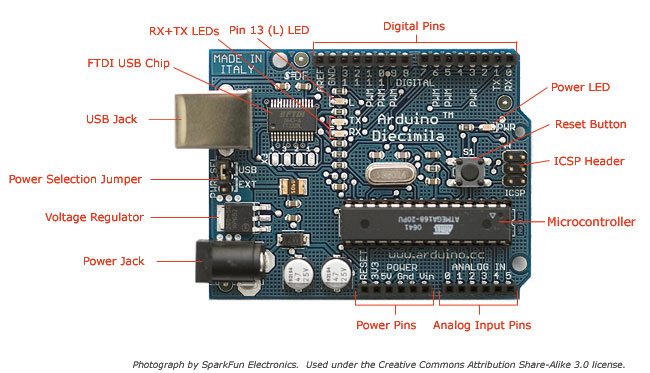
Arduino is an open well documented physical platform developed 2005 in the Olivetti town Ivrea, Italy. It is a platform which collect, compute and communicate data which makes it the perfect prototyping tool for students, hobbyists and professional developers to realize their device ideas. Today the affordable and easy to use development kits can be bought at the Radioshacks of the world. Nobody knows how many Arduino developers there are but over 300.000 boards have been sold, the ratio of cloning is currently estimated to one per original board and Arduino skills are more and more often requested in CVs.
Arduino supports Windows, Mac OS X and Linux and there are a number of boards available. They are really affordable and pre-assembled Arduino modules cost less than $50. The community is rapidly growing and it’s easy to join by for example following the Arduino blog.
Among the companies using Arduino for their tools and services are Google and Telefonica. And the more I dig into the world of M2M the more spectacular examples of Arduino projects I find. Imagine this: a 14 year old boy in Chile developed an Arduino machine which post a Tweet when detecting an earthquake and now this alert is sent to some 30.000 followers on Twitter.
This is only the beginning. The opportunities are massive but some risks are also involved. Many companies will experience difficult competition from unexpected directions and some will leverage these forces to strengthen their position in the market. Governments will see completely new solutions to old and difficult problems. And consumers will be offered new innovative services, many of them replacing products we buy today.
I’m fortunate to work and live in the middle of this period of great change!
Leave a Comment » | M2M | Tagged: Arduino, B3CC, B3IT, democratization of development tools, Google, Internet of Things, IoT, Ivrea, Linux, M2M, Mac OS X, Machine-to-Machine, Olivetti, Telefonica, Windows | Permalink
Posted by magnusmelander
May 18, 2012
 M2M solutions using Mobile operator’s networks are growing quite aggressively. According to Berg Insight we have some 110 Million M2M SIM cards active today. But even if this impressive growth continues we will never reach the connected society within my life time unless generic, cost efficient, easy to install and use alternatives comes to market. It is not primarily a matter of communication technology – it is a matter of connectivity together with services enablement making it cost efficient to develop applications. Such solutions will use fixed or mobile wan connections to connect to the Internet.
At May 16 I stumbled over the first potential solution to the “M2M for the rest of us” solution – Electric Imp. They just left stealth mode introducing a line of Imp cards that can be installed on any electronic device to put it online and control it. The cards connect to the Internet and a cloud based service using Wi-Fi. In their own words: “take the best implementation of hardware, firmware and cloud service, build them into a single mass-produced product, and apply them to any device in the world”. The word Imp is borrowed from Arpanet’s Interface Message Processor. Developer preview Imp cards and developer kits will be available this summer and Imp cards will retail for $25 when available in the market. Electric Imp claim they have invented a solution for configuring Imp devices for Wi-Fi networks in seconds using iOS or Android smartphones.
I find this exciting since it sounds like Electric Imp has what it takes: a generic, cost efficient, easy to install and use solution for connecting things to the Internet. As an evangelist and investor in the early Wi-Fi days I am also exited to see bets on Wi-Fi in the M2M field.
Electric Imp has a great idea, strong founders, capable investors and address a massive market opportunity. Their success will be determined by how fast they will get hardware vendors to adopt their platform and put Imp-slots in their devices.
Leave a Comment » | Cloud computing, Consumer market, M2M, M2M Service Enablers, Networks | Tagged: B3CC, B3IT, Electric Imp, Imp, Internet of Things, IoT, M2M, Machine-to-Machine, SIM, smartphone, WiFi | Permalink
Posted by magnusmelander
May 15, 2012

Security, efficiency and sustainability are the three key promises of M2M to businesses. And most applications of M2M address one or several of these straight forward issues in an organization: minimize use of service cars, avoid production stops, save valuable time with accidents, make processes more efficient, automate to avoid expensive labour work, etc. These are straight forward in the sense that we address concrete problems quite easy to put numbers on and investments can be verified using business cases and ROI. But the ultimate value of M2M comes from innovative business models, increased brand value and other less tangible things. And these are much more complicated to identify and dress in numbers. Innovation and creativity is clearly an important part of such efforts and I would suggest companies to look at the M2M consumer market to get ideas and cases to bring home.
There is actually a fourth promise of M2M which I normally don’t talk about to businesses – convenience. But in the consumer market this is a key driver and differentiator. Other reasons to look carefully at the consumer market are the typically limited budgets forcing innovative and cost efficient solutions and the absolute requirement for easy to install and use solutions. In addition consumers are generally more open to cloud services and many of them are early adopters with smartphones, pads and other gadgets. Examples of things and tricks to bring from the consumer space to business could be the use of smartphones to connect devices cheaply to the Internet and the host of innovative cloud services using sensors and gadgets in the growing personal health and fitness market. Imagine how much the home care providers can steal with pride from here! Take also a closer look at how well many consumer services enable their users to use any and all of their devices for the service. A lot to learn there.
And by the way, isn’t the Internet-of-Things a misleading name? There is only one Internet of People and Things.
Leave a Comment » | Business Models, Cloud computing, Consumer market, M2M, User Interaction | Tagged: B3CC, B3IT, business case, Business model, Internet of People and Things, Internet of Things, IoT, M2M, Machine-to-Machine, roi, usability | Permalink
Posted by magnusmelander
May 8, 2012
 Connecting things to the Internet opens up for a new wave of innovation to society, companies and consumers. That fact has been talked about and dressed in numbers for the last couple of years. Still we see quite little action beyond connecting “big phones” and electricity meters. Something is obviously missing and I think I know the answer.
We have good enough technology available and we have been blessed with a new category of smart mobile devices with apps perfect to visualize functionality and value for people. And we are in the beginning of the cloud and Big Data era which constitutes a perfect environment for M2M-applications and the data created. Still little action.
As often when powerful technology comes to market it is too abstract for most people to see how they and their organizations will benefit from it. What it will do to their life, business and society. Our industry needs to educate people and help them see the value and opportunities of M2M solutions. It is definitely not about technology – it is about business and should be discussed with business developers, product owners and management teams.
I believe a combination of meetings and a lot of relevant examples is what it takes to create understanding and feed a creative and rewarding thought process. The examples are most often not that your competitor did this, but rather someone in an adjacent industry did something and that was the result. Meetings with theoretical examples don’t work. We have seen some of that already and it sometimes feels like people from the M2M industry tell other people from the same industry how it works. And it is still too early to provide relevant ideas “stand alone”, without face to face meetings, since the context and overall education often is missing.
The method I am using with clients starts with an overview of the market (education) and continues with discussions about problems and challenges in their business relevant for M2M solutions. This normally becomes discussions about cost savings and efficiency which is great. Further down the road we look at business cases and ROI calculations. But the true power of the M2M concept comes to play when we start discuss potential new innovative ways of doing business enabled by M2M solutions. Collecting, cultivating and leveraging the data generated. Selling services or functions instead of products. Going from product life cycles to continuous R&D. Offering customers an unexpected service or feature. Effects to the brand and new weapons in recruiting employees or customers. This is what I believe is the real power of M2M solutions and the Internet of people and things.
This is what I call “M2M for real” and I will do my best to promote this approach beyond our company. A good acid test will be an “M2M For Real” event in Stockholm which the media company Mobil Business is organizing June 20, TeliaSonera is main sponsor and where we will provide a solid introduction and status update on M2M solutions followed by a “smörgåsbord” of examples from all kinds of industries and opportunities to discuss.
Leave a Comment » | Business Models, M2M | Tagged: B3CC, B3IT, Business model, innovation, Internet of Things, IoT, M2M | Permalink
Posted by magnusmelander
May 3, 2012
 An absolute requirement for M2M to really take off is a common architecture and a set of global standards. A robust common service layer is needed. The standardization organization ETSI started en effort to create such architecture and standard in January 2009 and has started to deliver. ETSI has released a multi-service layer enabling an easier and efficient access to the telecommunications network functionalities, designed to support a wide range of services over different underlying networks. It has to be noted that the work is IP only why issues like moving fax machines and other analog devices from PSTN to mobile networks isn’t covered.
According to Mr Enrico Scarrone, Chairman ETSI TC M2M, they try to build the standard on existing and available bits and pieces and focus on identifying gaps and fill them. At M2M Forum in Milan he presented also the oneM2M initiative which is a global partnership project aiming at removing the barriers for the Internet of Things created by local and industry related differences and approaches. We all know the power of 3GPP which strongly supported the developments of the third and fourth generations of cellular networks. Hopefully oneM2M will pave the way for a rapidly growing Internet of Things where data from different industries can be combined to create new innovative solutions and business models.
Leave a Comment » | M2M, M2M Service Enablers | Tagged: 3GPP, B3CC, CSD, Enrico Scarrone, ETSI, Internet of Things, M2M, M2M Forum, oneM2M, PSTN, Standards | Permalink
Posted by magnusmelander
April 24, 2012
 Services like Skype and Spotify utilizing the Internet just as a connection are often referred to as over the top services or OTT. Consumers normally love them but operators typically have a more complex view of them: great since they create demand for their IP services but not that great if they replace services the operators charge for. Most M2M applications are really tiny in terms of traffic generation which explains why over 95% of the mobile ones still use 2G. For mobile operators M2M is more of a subscription business than a data business today. It is hard to estimate how M2M solutions will impact data volumes since it’s a combination of actual applications and volumes of connected devices.
I always claim that the M2M consumer market is a great place to look for innovation and interesting examples to bring to the business market. One example is what could be referred to as M2M OTT, where vendors of connectable devices use people’s ordinary mobile devices to connect to the Internet and an application in the cloud or elsewhere. This can make the device cheaper and smaller to manufacture and use. By using for example Bluetooth to connect to the phone and leverage the existing subscription and data plan. Data from the device can be made available to an application somewhere typically adding no cost to the user. And no new revenues but more traffic to the operator. There are many examples of this in the consumer market today and the personal health and fitness segment is one worth looking at. A mix of books, trends, research, services and products has created a rapidly growing movement and industry. Dr David B. Agus’ bestseller “the end of Illness” and the sleep monitor Zeo are good examples. The Zeo is a complete system taking sleep analysis out from the labs. By connecting a Zeo headband to an iPhone or Android phone via Bluetooth, the sleep data collected is made available to an app for reporting. But the sleep history data is also made available to the user’s account at mysleep.myzeo.com where analysis, backup and other services are available.
Using the mobile devices for local collection and presentation of data and access, over the top, to an application and services in the cloud is a model we can use in other situations. There are obviously downsides having to deal with Bluetooth, phones running out of power or stolen etc. But for some applications this is a great model maybe also in the business environment. There is simply not one or two models for M2M but many, and it is important to carefully look at all possible approaches available when implementing an M2M project.
Leave a Comment » | Cloud computing, Consumer market, M2M, Networks | Tagged: 2G, Agus, Android, apps, B3CC, B3IT, Bluetooth, Internet of Things, IoT, iPhone, M2M, Machine-to-Machine, OTT, over the top, SIM, smartphone, zeo | Permalink
Posted by magnusmelander
 A lot of people and animals are killed and injured in road traffic, road vehicles impact our environment significantly and road traffic is an important part of efficient transportation of people and goods. With the key promises of M2M being safety, sustainability and efficiency there is a perfect match between road traffic and M2M. A lot of research projects are on-going and part of the overall efforts towards the ITS (Intelligent Transportation Systems) vision.






 connectcompute