Road traffic 2.0

August 17, 2012

A lot of people and animals are killed and injured in road traffic, road vehicles impact our environment significantly and road traffic is an important part of efficient transportation of people and goods. With the key promises of M2M being safety, sustainability and efficiency there is a perfect match between road traffic and M2M. A lot of research projects are on-going and part of the overall efforts towards the ITS (Intelligent Transportation Systems) vision.

The air traffic system has for many years been developed aiming towards zero accidents. This process has made air traffic very safe and I am told that most of the remaining accidents are caused by human beings. The use of UAV (Unmanned Aerial Vehicle) and UCAV (Unmanned Combat Aerial Vehicle) is increasing mainly to avoid dull, dirty or dangerous flying missions. We have for example all heard about drone attacks (military planes without pilots) in countries like Pakistan and Afghanistan.

If we can fly helicopters and aircrafts without pilots we must be able to modernize the road traffic to make it safer, more friendly to nature and more efficient. And even if humans cause many or maybe most of the problems on the road we still don’t feel comfortable putting ourselves in the hands of technology on the roads or in the air. But this will change. The technical solutions are ahead of what we are willing to accept but carefully managed real life trials together with clear and big benefits will slowly make us humans agree to start using new solutions.

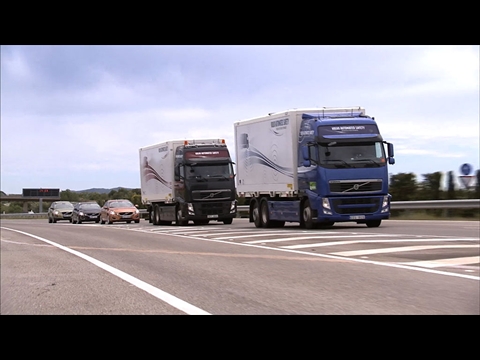
There are many advanced research projects in road traffic continuously pushing the frontier forward. Earlier this summer Volvo successfully led a road train consisting of a Volvo XC60, a Volvo V60 and a Volvo S60 behind a truck on a 200 km journey through Spain as part of SARTRE (Safe Road Trains for Environment). The cars outfitted with cameras, radars and laser sensors were six meters apart and drove safely 85 km/h without any driver interference. The vehicles in the test have covered some 10.000 km on test circuits before the trial. Beyond improved safety and sustainability road trains would allow us drivers to put a professional driver in command for a while, take a bite, check our mail and take a nap before taking control of the car again. Sounds great!Another interesting project is Google Driverless Cars. In May 2012 the first license for a self-driven car was issued in Nevada: a Toyota Prius modified with Google’s experimental driver-less technology. The team just announced that they have completed over 300,000 autonomous-driving miles accident-free, typically have about a dozen cars on the road at any given time, and are starting to test them with single drivers instead of in pairs.

ITS World Congress 2012 in Vienna October 22-26 is an interesting event for anyone interested in where road traffic is going. I’ll be there!


Single purpose M2M solutions

August 4, 2012

Single purpose M2M solutions have started to appear in the market. They are typically addressing one specific problem with a combination of hardware, software and communication. If the problem addressed is clear and considered big enough by many people and the solution works well then the willingness to pay should be possible to build a business around. Provided the solution uses the cloud to deliver the service from, then expanding the solution to include generic devices like smartphones, pads and PCs is an interesting next step at least to access the data but maybe to run the entire application on as well.

A good example is Coyote from France who claims over 1.7 million users of their speed camera alert system in Europe. The service is also available as an app for iPhone/iPad, Android, Blackberry and for Parrot. A Coyote device cost about 250€ including one year of service. A solution like this is also interesting for mobile operators since one agreement can sell hundreds of thousands subscriptions of the same type and each deal like this provides opportunities to add service enablement services on top of the connectivity.

The two key success factors of products like these are a high quality solution to a reasonable big problem and ease-of-use out of the box. Then people are willing to pay reasonably well for the service and word of mouth will work for marketing. Easy to buy and use solutions are also interesting in sales channels. It is quite likely that we will see many more single purpose M2M solutions onwards.


eCall – life saver or business enabler?

July 3, 2012

The European Parliament just adopted a resolution where they call on the European Commission and Member States to make sure eCall is installed in every new vehicle by 2015. The Parliament consider this resolution a major step towards the roll-out of eCall in Europe that will have a significant impact on citizens’ safety.

This is certainly a good intention and with 35-40.000 Europeans killed and over a million injured in road accidents per year something needs to be done. But it is not obvious that eCall will make a big difference in that regard. Some countries don’t have national response centers which will make implementation more difficult and similar services from car manufacturers haven’t really become commercially popular. I guess the road towards less road traffic accidents starts with better drivers, better cars and better roads but I obviously hope eCall will save a lot of lives.

But connecting all new cars in a similar fashion could potentially make a difference in other ways. If some data would be made more openly available we could see a lot of new innovative services made available to drivers, owners, insurance companies and government agencies. Imagine apps like the Volvo App managing the parking heater etc becoming available for all cars, maintenance data becoming available to third party service companies, real time position data available to ITS systems, etc. And if some of these services really would take off the vehicle M2M retrofit market would be huge. We all know it by now: data is the gold of M2M.


M2M in cars

January 23, 2012

The car industry was early adopter of M2M solutions. Wireless systems where the car called for assistance in case of an accident was introduced early on. Two major early initiatives where OnStar formed by GM together with EDS and Hughes already 1995 and Wireless Car started 1999 by Volvo, Telia and Ericsson. GM started to use an analog OnStar solution in Cadillac DeVille, Seville and Eldorado models from fall 1996 which created a lot of discussions and interest in both the car and telecom industries. The idea of connected cars was and still is a great idea and the connections would be used for a lot of great things. Initial reports talked about the rapidly increasing number of cars equipped with the service and entrepreneurs, car manufacturers and investors (including me) invested in this promising idea. But after a while, when car owners were supposed to pay for the service which typically was delivered for free at purchase, usage dropped significantly. Exciting visions surfaced and most was based on a 3G broadband connection to the car to download music and movies to the in-car entertainment systems, maps to the in-car navigation systems, etc. We do actually enjoy music, video and navigation in cars today but most often with our own devices brought to the car and the car manufacturers more focused on connectivity for these devices than in-car systems. It’s actually quite similar to the BYOD (bring your own device) development we see in enterprises today.

It has taken the industry 10-15 years to come up with cost efficient and attractive solutions for connected cars and today OnStar is a subsidiary of GM and Wireless Car is owned by the Volvo Group reporting into Volvo IT. OnStar claims more than 6M subscribers now and their primary network partners are Verizon (US), Bell Mobility (Canada) and China Telecom. They offer a range of services including emergency, vehicle diagnostics, directions and stolen vehicle tracking. Their plans are typically between 20 and 30 US$/m. Wireless Car of today describes themselves as an automotive telematics service provider (TSP) providing manufacturers of cars and commercial vehicles with customized telematics services to end customers world-wide. Among their reference customers are Volvo Cars, Volvo Trucks, Volvo Construction Equipment and BMW.

Looking at these two M2M-in-cars pioneers is interesting: they are both in business, they are integrated in GM and Volvo Group presumably for strategic reasons and they have both tried different technical solutions, business models and focus areas. But even though they started at more or less the same place, they ended up as quite different businesses. While Wireless Car is more of a generic telematics provider world-wide, OnStar remain focused on the cars with a quite rich and innovative portfolio (I love the stolen vehicle slow down feature) in targeted geographies.

Connecting vehicles to the Internet is required to address a whole range of issues including community wide ones like sustainability, safety and security as well as issues for owners and drivers of vehicles like cost of ownership, efficiency and convenience. The commercial vehicles are in most cases ahead of cars when it comes to being connected because of a combination of legislation and business benefits. The consumer fleet is not really connected yet due to a combination of difficulties to see good affordable deals and availability of good alternatives for some of the needs like music and navigation. But I think this is changing now since the solutions are becoming affordable, innovative use of the connectivity together with apps on smartphones and pads gives users very concrete advantages (i.e. turn on my heater) and last but not least government policymakers push for connected cars. The eCall project in EU for example aims at having a fully functional road assistance service in place across all EU countries by 2015 and connecting the cars is of course a requirement. The emergency data is automatically sent from the vehicle to a local emergency center and the aim is faster response to minimize death and injuries of people involved. And this is serious: according to CARE (EU road accidents database) some 35.000 people die and 1,5 million are injured in road accidents per annum in Europe (the leading cause of death in EU for people under 50 years old) to be compared with some 1.500 deaths in rail accidents and some 50 on an average in air accidents.

The transport industry is my personal favorite M2M market since it is huge and complex, the three M2M promises (efficiency, sustainability, safety/security) are all very relevant, the challenges are humongous and we have a common vision and framework in place with ITS.


Traffic and Transportation

November 19, 2011
Traffic and transportation has what it takes to become an enormous market for M2M solutions. Many types of vehicles in separate complex systems utilize dedicated or shared infrastructure providing services to governments, enterprises and individuals. All individuals and organizations in the world utilize the transport systems directly or indirectly on a daily basis and are directly impacted by how well it works. The combined turnover of the transport systems is astronomic and saving a fragment of a percent here and there makes enormous impact.The three key promises for M2M solutions – sustainability, safety & security and efficiency– are all very relevant in the transportation systems. Vehicles consume a lot of the energy and create a lot of the problems in the environment. Transportation systems are important or critical infrastructure and traffic kills and injures a huge amount of people every year. Efficient transportation systems brings efficiency to individuals and organizations which impact wealth and quality of life for people as well as good business and investment climate for companies. Efficiency also enables the public sector to do what they are supposed to do with fewer resources.

ITS – Intelligent Transportation Systems– is a “vision” for how the complete transport system should look like, identifying key questions and priorities, standardizing language and interfaces, sharing best practices and so on. It has been under development since many years in national, regional and global ITS organizations. Even though ITS brings more questions than answers and continuously undergoes change it serves an important role to pull forces together behind a common objective, across industries and boarders. It becomes in a way a loosely connected research effort with people and organizations from both public and private sector focusing on different parts of the universe while getting influence and ideas from other parts. This “structured sharing in a common framework” is a good approach for innovation in the Internet era.

Transportation systems are historically divided into separate systems for each type of transportation: rail, air, road, etc. Due to organization and responsibilities the different systems are rarely synchronized. In order to build a transportation system that delivers what we want, we need to take on a holistic approach and make the individuals part of the system. If I have a choice between taking my car to a customer meeting or a combination of bus and Metro, I need a complete and real-time comparison of these alternatives delivered on the device I currently use at the time for my decision. Tickets and payments has to be easy to deal with not to prevent least resistance choices.

The only possible way to reach a smart, efficient, convenient, secure, safe and environmentally sound transportation system is to connect vehicles, infrastructure and people together and then put a lot of computing on top. This is a massive task which will create an ICT business opportunity in the size of a new Internet over the next decades. And this is why Transportation is one of the most interesting fields for M2M solutions.