May 15, 2012

Security, efficiency and sustainability are the three key promises of M2M to businesses. And most applications of M2M address one or several of these straight forward issues in an organization: minimize use of service cars, avoid production stops, save valuable time with accidents, make processes more efficient, automate to avoid expensive labour work, etc. These are straight forward in the sense that we address concrete problems quite easy to put numbers on and investments can be verified using business cases and ROI. But the ultimate value of M2M comes from innovative business models, increased brand value and other less tangible things. And these are much more complicated to identify and dress in numbers. Innovation and creativity is clearly an important part of such efforts and I would suggest companies to look at the M2M consumer market to get ideas and cases to bring home.
There is actually a fourth promise of M2M which I normally don’t talk about to businesses – convenience. But in the consumer market this is a key driver and differentiator. Other reasons to look carefully at the consumer market are the typically limited budgets forcing innovative and cost efficient solutions and the absolute requirement for easy to install and use solutions. In addition consumers are generally more open to cloud services and many of them are early adopters with smartphones, pads and other gadgets. Examples of things and tricks to bring from the consumer space to business could be the use of smartphones to connect devices cheaply to the Internet and the host of innovative cloud services using sensors and gadgets in the growing personal health and fitness market. Imagine how much the home care providers can steal with pride from here! Take also a closer look at how well many consumer services enable their users to use any and all of their devices for the service. A lot to learn there.
And by the way, isn’t the Internet-of-Things a misleading name? There is only one Internet of People and Things.
 Leave a Comment » |
  Business Models, Cloud computing, Consumer market, M2M, User Interaction | Tagged: B3CC, B3IT, business case, Business model, Internet of People and Things, Internet of Things, IoT, M2M, Machine-to-Machine, roi, usability |
  Permalink
 Posted by magnusmelander
May 8, 2012
 Connecting things to the Internet opens up for a new wave of innovation to society, companies and consumers. That fact has been talked about and dressed in numbers for the last couple of years. Still we see quite little action beyond connecting “big phones” and electricity meters. Something is obviously missing and I think I know the answer.
We have good enough technology available and we have been blessed with a new category of smart mobile devices with apps perfect to visualize functionality and value for people. And we are in the beginning of the cloud and Big Data era which constitutes a perfect environment for M2M-applications and the data created. Still little action.
As often when powerful technology comes to market it is too abstract for most people to see how they and their organizations will benefit from it. What it will do to their life, business and society. Our industry needs to educate people and help them see the value and opportunities of M2M solutions. It is definitely not about technology – it is about business and should be discussed with business developers, product owners and management teams.
I believe a combination of meetings and a lot of relevant examples is what it takes to create understanding and feed a creative and rewarding thought process. The examples are most often not that your competitor did this, but rather someone in an adjacent industry did something and that was the result. Meetings with theoretical examples don’t work. We have seen some of that already and it sometimes feels like people from the M2M industry tell other people from the same industry how it works. And it is still too early to provide relevant ideas “stand alone”, without face to face meetings, since the context and overall education often is missing.
The method I am using with clients starts with an overview of the market (education) and continues with discussions about problems and challenges in their business relevant for M2M solutions. This normally becomes discussions about cost savings and efficiency which is great. Further down the road we look at business cases and ROI calculations. But the true power of the M2M concept comes to play when we start discuss potential new innovative ways of doing business enabled by M2M solutions. Collecting, cultivating and leveraging the data generated. Selling services or functions instead of products. Going from product life cycles to continuous R&D. Offering customers an unexpected service or feature. Effects to the brand and new weapons in recruiting employees or customers. This is what I believe is the real power of M2M solutions and the Internet of people and things.
This is what I call “M2M for real” and I will do my best to promote this approach beyond our company. A good acid test will be an “M2M For Real” event in Stockholm which the media company Mobil Business is organizing June 20, TeliaSonera is main sponsor and where we will provide a solid introduction and status update on M2M solutions followed by a “smörgåsbord” of examples from all kinds of industries and opportunities to discuss.
Leave a Comment » | Business Models, M2M | Tagged: B3CC, B3IT, Business model, innovation, Internet of Things, IoT, M2M | Permalink
Posted by magnusmelander
April 24, 2012
 Services like Skype and Spotify utilizing the Internet just as a connection are often referred to as over the top services or OTT. Consumers normally love them but operators typically have a more complex view of them: great since they create demand for their IP services but not that great if they replace services the operators charge for. Most M2M applications are really tiny in terms of traffic generation which explains why over 95% of the mobile ones still use 2G. For mobile operators M2M is more of a subscription business than a data business today. It is hard to estimate how M2M solutions will impact data volumes since it’s a combination of actual applications and volumes of connected devices.
I always claim that the M2M consumer market is a great place to look for innovation and interesting examples to bring to the business market. One example is what could be referred to as M2M OTT, where vendors of connectable devices use people’s ordinary mobile devices to connect to the Internet and an application in the cloud or elsewhere. This can make the device cheaper and smaller to manufacture and use. By using for example Bluetooth to connect to the phone and leverage the existing subscription and data plan. Data from the device can be made available to an application somewhere typically adding no cost to the user. And no new revenues but more traffic to the operator. There are many examples of this in the consumer market today and the personal health and fitness segment is one worth looking at. A mix of books, trends, research, services and products has created a rapidly growing movement and industry. Dr David B. Agus’ bestseller “the end of Illness” and the sleep monitor Zeo are good examples. The Zeo is a complete system taking sleep analysis out from the labs. By connecting a Zeo headband to an iPhone or Android phone via Bluetooth, the sleep data collected is made available to an app for reporting. But the sleep history data is also made available to the user’s account at mysleep.myzeo.com where analysis, backup and other services are available.
Using the mobile devices for local collection and presentation of data and access, over the top, to an application and services in the cloud is a model we can use in other situations. There are obviously downsides having to deal with Bluetooth, phones running out of power or stolen etc. But for some applications this is a great model maybe also in the business environment. There is simply not one or two models for M2M but many, and it is important to carefully look at all possible approaches available when implementing an M2M project.
Leave a Comment » | Cloud computing, Consumer market, M2M, Networks | Tagged: 2G, Agus, Android, apps, B3CC, B3IT, Bluetooth, Internet of Things, IoT, iPhone, M2M, Machine-to-Machine, OTT, over the top, SIM, smartphone, zeo | Permalink
Posted by magnusmelander
March 30, 2012
 This post was published on M2M Daily March 15, 2012: http://www.m2mdaily.com/m2m-editorials/m2m-enables-new-business-models/
Many industries end up in the huge global market with ever increasing competition putting immense pressure on cost, performance, functionality, service, etc. One approach to change game plan is to change business model from selling products to selling functionality. Something-as-a-service and pay-per-use are concepts along those lines. It is likely that clients in general prefer such offerings since it feels fair to pay for use, it feels good not to have to take care of product problems and in relevant cases it’s great not even having to host or see the products. For vendors it is easier to manage manufacturing, production and service if they own the products, they improve R&D since they get to know everything about the product life cycle but they will get their revenues distributed over maybe 34 to 60 months instead of up front. That is horrifying and require a lot of change to any company going down this path.
M2M is a key enabler to business transformation. Today we can connect products to the vendor’s relevant systems for planning, maintenance, financial reporting, invoicing, support, etc. From a technical point of view this enables change of business model to for example a pay per use model. Since we can monitor, control and manage the products remotely we can constantly improve everything that relates to the product during its life cycle including preventive maintenance, tune for more efficient energy consumption, decrease downtime due to alarms, make software upgrades over the air, etc. These are obviously relevant benefits also with a traditional business model but the point is that with full control of a product through out its life a service oriented business model looks more attractive.All of this is pure technical and no one should underestimate the complexity from a business, organization, systems and management point of view to make changes like this. But still, M2M makes it technically possible today.
We see an increasing number of cases where companies connect their products but it is most often to improve a specific thing like maintenance. And the risk is that the technical implementation works for the purpose but can’t support the next request coming up somewhere else in the company. It is still quite rare that vendors also change the business model but there are interesting examples of companies who do. Innovative business models seem more for newcomers than for established businesses. If it ain’t broken, don’t fix it! Well, if it is a good idea someone will do it and it might be disruptive.
I would argue that now is the time for companies to start look into these things. Keep an eye of what competitors and players in adjacent industries does, start play with ideas of what we could do if we connected our products and what the results would be. And most importantly, if you decide to get going, ensure you build a solution supporting needs you might have over the life time of the products.
Leave a Comment » | Business Models, M2M | Tagged: as-a-Servcie, B3CC, B3IT, Business model, Internet of Things, IoT, M2M, Machine-to-Machine, Pay-per-use, R&D | Permalink
Posted by magnusmelander
March 23, 2012
 A key challenge for the M2M industry right now is to enable time and resource efficient development of specific M2M applications to industries or even companies. As soon as the interesting devices are connected in a proper way, data needs to be collected, organized and combined with other relevant data in order to provide useful information to new or existing applications. Devices need to be monitored, alarms have to be taken care of and maybe even transfer of money needs to be handled. This is what is done in M2M Services Enablement systems – the key to successful M2M deployments.
The Services Enablement systems can be deployed in three different ways: as extensions to operator connectivity offerings, as independent services from a third-party or as an in-house service to support M2M initiatives. It seems obvious that devices in many cases will be connected using a mix of technologies which further complicates this issue. It is my experience that we always end up in different communication technologies for wide area networks, local area networks and personal area networks/short-range communications. And even though wireless most often is preferred when feasible, also fixed networks will be used onwards. Needless to say, it is challenging to build a Services Enabler solution and to choose which solution to use in a specific situation.
We need to make it easier for potential customers to understand and decide which type of solution to use in order to accelerate deployments of real M2M solutions. Six Swedish companies just joined forces under the name of “Swedish M2M Service Enablers” in an ambition to start work together on educating the market on the importance of Services Enablement solutions and to try establish some common language and even APIs. The collaboration is also an attempt to market the companies to customers and partners abroad. Please visit http://www.swedishm2m.se to read more about the initiative or take a look at the press release issued today at http://www.mynewsdesk.com/se/view/pressrelease/swedish-m2m-services-enablers-initiative-launched-to-jointly-promote-swedish-companies-with-world-class-solutions-744720
Leave a Comment » | M2M, Networks | Tagged: B3CC, B3IT, Internet of Things, M2M, Machine-to-Machine, open api, SMSE, Swedish M2M, Swedish M2M Services Enablers | Permalink
Posted by magnusmelander
February 14, 2012
 The connecting part of M2M is not really the interesting one, it’s the enabler. The computing part is the interesting one and where most value is created. Connecting things becomes easier and easier technically, practically and financially. Meanwhile the computing power in the cloud is developing immensely fast. Making information collected from machines and other relevant sources available to Internet application developers using the computing power available in the cloud will push innovation to new heights provided security and integrity is taken care of properly. By utilizing computing power in the cloud, devices can be lighter, faster, cheaper and optimized for other things like interaction and usability in something quite similar to the good old client server architecture.
Governments around the world try to support their local high tech industry and most cities today have their local incubators, investment funds and support programs. A quick and quite affordable way for governments on all levels to push and support innovation is to provide access for developers to data produced in the public sector and to promote, maybe push, usage of modern innovative information technology. The access must be affordable and not too complicated for the developers.
EU issued already 2003 the PSI directive – Directive on the re-use of public sector information – which was built on the two key pillars of the internal market: transparency and fair competition. The directive defined minimum rules for re-use of PSI and recommended states to go beyond these rules and adopt open data policies. Several countries including Sweden have been chased by the Commission for slow or poor implementation of the PSI directive which in the case of Sweden is strange since we have had our legislation regarding freedom of information including the right to reprint official documents since 1766. In the most recent version of the directive, 2012, also museums, archives and libraries are covered in the scope.
Most data produced within governments remain there and their ability to attract developers to make innovative and useful applications and services for citizens and society are limited. The growing number of M2M solutions deployed will drastically increase the amount of useful data created why countries acting now will have a growing advantage to others.
1 Comment | Cloud computing, M2M | Tagged: B3CC, B3IT, Internet of Things, open api, PSI, Public Sector Information | Permalink
Posted by magnusmelander
January 29, 2012
 Today some 95% of the mobile M2M connections are 2G. It is absolutely natural since the functionality and capacity needed for most of today’s applications is fulfilled in 2G and the modules are substantially cheaper. An off the shelf 2G SIM card would cost around $3-4 per month plus $0,5-2/MB data transmitted (in Sweden) and CSD, GPRS and SMS is enough for most M2M applications today. But there are dark clouds in the horizon! We don’t know how far away or how fast they come forward, but they are definitely there. Let’s try look at what these clouds contain.
A typical M2M deployment would count on terminals to be in service more than five years, often 10 or even 15 years. That’s long time! It is about 20 years since the GSM services came to market, and betting on the same networks to still be there with great coverage and good service might be something to consider carefully. A customer service person at my previous mobile operator in Stockholm told me: “sorry but we don’t invest in the 2G network anymore”. One of my companies, Possio, help mobile operators to move analog devices from the fixed network, PSTN, to mobile networks using primarily circuit switched connections in 2G (CSD). They experience operators, one by one, deciding not to introduce any new CSD based services in their network. They keep the existing ones, but obviously not for ever. I believe CSD will not disappear over night but this is worth looking into when making the bets
The connect part of M2M is the least interesting and rewarding. It is the compute part that makes the difference. IP is today, by all means, the dominating communication platform across all industries. The IP development environment is solid and rich, application support endless and skill is really everywhere, from developers to support people. An M2M bet today should in most cases be built on IP and one should really try understand if performance in 2G GPRS/EDGE will be enough for making all wanted computing during the life cycle. It is easy to foul yourself when it comes to performance and capacity. My first business trip with IBM went to Copenhagen 1983 where serious old men unanimously stated that with this capacity nothing is stopping us any longer. This was an ISDN conference.
The end-of-life problem is always something to take into account. Module manufacturers normally bring to market new pin compatible modules for their most popular models. But one day they will issue an end-of-life notice and then it is last order date and finally the spot market to rely on before it is over. In other words, when a market decrease it’s a chicken race between the module vendors. They not only want to understand how fast the market disappears (remember they have good numbers to watch) but they also want to ensure the best moment to bring their customers forward on a new platform and not lose them to a competitor.
The cost of modules for 2G or 3G differs a lot. As of today a 3G module would be roughly double the price of a 2G module and the difference could be $25-30. That is a lot especially if you need many. But it is important to look at the entire cost envelope, both capex and opex, over time. The cost of the actual deployment is normally high since it takes human beings to prepare the installation, to ensure other people involved are available, to get and verify permission for entrance and finally to go on site. Each installation is obviously different depending on industry, security levels, distances, type of application, etc but it can easily take a couple of hours per terminal which would translate into hundreds of dollars. One of my companies is active in retail environments where they often experience a lot of problems especially with access permission and coordination with other people needed (electricians, operator staff, alarm staff, etc). This is why we need to get it right first time – we can’t afford to go back – and why the installations will have to be operational for many years. When planning an M2M solution this might well be the most important aspect of the business case and the biggest risk for failure.
I believe this question – should I stay or should I go – is very important for all of us in the M2M business. There are no generic answers to the question about going 2G or 3G but it seems inevitable that sooner or later 3G will be the primary network why focus and investments thus quality and coverage in 2G networks will erode. How fast this happens is of course also depending on geography. In order to put more light on this important question I will ask a couple of knowledgeable individuals from within the industry about their views and post them here.
1 Comment | M2M, Networks | Tagged: 2G, 3G, B3CC, B3IT, CSD, Internet of Things, IoT, isdn, M2M, Machine-to-Machine, modules, networks, Possio, PSTN | Permalink
Posted by magnusmelander
December 27, 2011
 Utilities normally come up first when talking M2M. Primarily electricity but also water and gas. It’s huge global businesses and infrastructures dealing with things that are closely related to the sustainability issues as well as safety and security, everyone on the planet including politicians are involved one way or another and on top it’s one of few areas where M2M solutions already have been used in large scale. Many utility companies have telecommunication business experience which makes them knowledgable buyers.
Smart Grid is the white paper or vision for how the electricity industry will cope with the new world where production, distribution and consumption of electricity is managed in real time all around the grid and where usage is optimized over time. The basic idea is to connect everything and add computing on top. If the smart grids happen we are looking at a new industry of “Internet size” in 30-50 years which has made many large corporations starting to dig there already.
Given the limitations of our globe it is obvious that we have to do something and I am convinced “connecting and computing” is a major part of it. But the scale of the project means it will take a lot of time, financing has to be sorted out, concepts and solutions have to be proven and so on, which explains why we still see primarily pilot projects and trials. And when it happens big way, most of it will be a game for large players with big projects and thin margins like most infrastructure business.
The first step towards the smart grids are connected electricity meters for automated meter reading (AMR) and we are in the middle of that huge roll out project right now. Global shipments of smart meters exceeded 100M 2011 and is estimated to be 250M by 2016 (ABI Research). EU wants 80% of the meters to be smart by 2020 and Italy and Sweden are already done. North America has already more than 50% meters connected (Berg Insight) after the American Recovery and Reinvestment Act (ARRA) which included US$ 43 Billion plus tax incentives for the energy sector. Also Asia is speeding up their efforts with Japan having the most advanced power grid monitoring systems in place, China announcing a five year AMI plan, Singapore working on their Intelligent Energy System and South Korea their Smart Grid Demonstration Project. Some 1,5B smart meters will be deployed during the next 10 years and meter manufacturers like Landis & Gyr, Sensus and Itron and communication module providers like Telit, Cinterion and Sierra Wireless are all working hard to capture this big business opportunity. But since the traffic per smart meter is tiny (probably less than half MB per year) it is not obvious that the smart meters is the salvation for network providers. A mix of different technologies is used to connect the meters to the central applications. Reportlinker estimates 38% of M2M connections in the utilities industry today to be cellular connections growing to 57% by 2020. MAN, including power line communications (PLC) and community WiFi, accounts for 53% today and is estimated to 28% by 2020.
Even though energy companies and governments are keen on rolling out smart electricity meters some consumers are not. Several US consumer groups like in Naperville, Illinois, are fighting the smart meter roll-outs in order to give the consumers the option to stay with the old meters. But more often consumer groups are pushing smart meters to put the consumers in control.
Replacing meters for electricity, water and gas with smart ones is only the beginning. Making the grids smarter will require a lot of relevant networks and IT systems to be made available. The grids are also part of the national critical infrastructure protection efforts why I believe we will see governments getting very much involved in how to build, operate and protect this infrastructure onwards.
Leave a Comment » | M2M, Safety and Security, Utilities | Tagged: AMR, B3CC, B3IT, centerion, CIP, Critical Infrastructure, Internet of Things, IoT, Itron, Landis & Gyr, M2M, Machine-to-Machine, PLC, sensus, Sierra wireless, smart grid, telit, WiFi | Permalink
Posted by magnusmelander
December 14, 2011
What networks are used for M2M applications today? We know a lot of applications use the fixed network (PSTN) but I lack data on that. I visited a friend with a quite small but modern grocery store the other day and beyond the main connection provided by headquarters for cash registers, computer systems, telephony etc, he has three separate PSTN lines to his shop: one for a video surveillance system, one for recycling machines and one for an alarm. When talking to a friend at a fixed line operator recently he mentioned that they have energy companies with water power plants with thousands of PSTN subscriptions for level gauges.
The 2G networks are by all means the most utilized mobile networks for M2M today. Beecham Research claims over 95% of M2M applications use 2G today. Good coverage, reasonable prices, limited capacity required, affordable modules and history explains this situation. And despite push for 3G from vendors and operators, not a lot is happening except for some specific applications. Vendors obviously want to sell new products and some operators want to re-use 2G spectrum or move users for other reasons. For people developing or operating an M2M solution a key question must be to understand when the time is right to change from 2G to 3G (if ever) and how to implement the change. A clear detailed roadmap could be a competitive edge for an operator. Interestingly enough some, primarily vendors and operators, already claim 4G is the way to go for M2M.
Most of Ericsson’s modules business ended up in ST-Ericsson some years ago and they re-entered in 2007 to provide cost effective broadband modules to be built into PCs. Quite silently they announced the end of their broadband modules business in December 1, 2011. The reason provided for the exit was: “our position on the market does not provide the scale we need to achieve the desired profitability”. I believe the actual size of the market for 3G modules also is part of the explanation. ABI claimed last summer: “USB configurations are outselling embedded modems by a ratio of more than three to one” and expected USB configurations to stay bigger until at least 2017.
3G has been around for some ten years now and in dense populated areas it is heavily utilized and 4G is starting to be deployed. But in rural areas most people relay on 2G (some even don’t have 2G) and in some developing countries they haven’t even started to deploy 3G yet. In the end of the day it is market requirements that decide when and to what extent networks will be built, upgraded and utilized, not operator or vendor desire. Still today most M2M applications don’t need much more than decent connectivity (I don’t include Pads, tablets and Smartphones in M2M), and for these to go 3G we need competitive coverage, prices and module prices compared to 2G.
Leave a Comment » | M2M, Networks | Tagged: 2G, 3G, 4G, B3CC, B3IT, Ericsson, Internet of Things, IoT, M2M, Machine-to-Machine, PSTN | Permalink
Posted by magnusmelander
December 7, 2011
 Users
Users are typically more interested in what things and services do or deliver than how they work. They want to get the work done. Still most products and services are too cumbersome to install and use and even if they help solve important problems people are reluctant to buy and use them. Coming from IBM to Apple at the time for the Mac made me see the difference between function centric and user centric development approaches.When there is a reasonable choice,
users always chose the products they like. Some 3,5 billion people had a mobile phone when the iPhone was launched June 29 2007. It brought a completely new user experience to the market and despite many technical limitations and a high price it rapidly and fundamentally changed the mobile industry. Operators were chocked and Nokia lost. There has always been application developments for mobile phones but by enabling any and all developers to develop easy to install and use apps for millions of iPhone users and efficiently distribute and maintain them, enormous forces were released. All of a sudden a completely new way of solving small to big problems was at hand and a massive amount of apps were made available. Like when Internet took off many said “there is mainly useless garbage around”. Development started from the users. The users downloaded some 30B apps 2011 and the revenues are expected to be some 15B$ (Gartner). The users are kings.
The relevance of this for M2M is that whenever users will be involved, they must be able to use the device or devices of their choice to interact with the service. And the usability of the service needs to be in pair with what they are used to already. There will continue to be several terminal platforms and we have to support them all even if it is hard. Up until now most employers had standardized terminals but also that is changing rapidly. BYOD – Bring Your Own Device – is spreading like wildfire promoted by Cisco and others. In essence we can chose between developing apps for the different platforms, using HTML5 or using cross platform tools like MoSync, PhoneGap and Appcelerator. These choices are critical since the success of an M2M service depends on how they interact with their users.
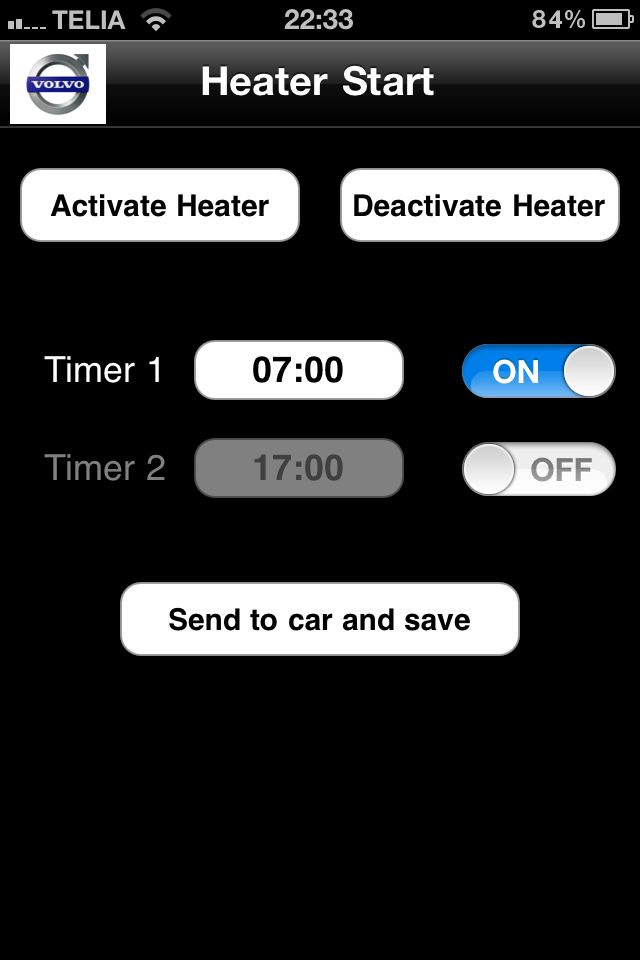
Volvo cars released an iPhone and Android app in June 2011 which use their On Call cellular service to allow users to lock the car, find their car, look at the dashboard, start the parking heater and other useful things. I’m told the app is a roaring success and if so I believe the reason is that Volvo car owners immediately understand which problems it solves for them, how it works, they can use their device of choice and it works like anything else on that device. The entire On Call technology, system and networks are invisible to them. It just works. That is a good example of how I believe M2M solutions should interact with their users.
Leave a Comment » | M2M, User Interaction | Tagged: apps, B3CC, B3IT, BYOD, Internet of Things, IoT, M2M, Machine-to-Machine, On Call, usability, user, User interaction, Volvo | Permalink
Posted by magnusmelander
 Security, efficiency and sustainability are the three key promises of M2M to businesses. And most applications of M2M address one or several of these straight forward issues in an organization: minimize use of service cars, avoid production stops, save valuable time with accidents, make processes more efficient, automate to avoid expensive labour work, etc. These are straight forward in the sense that we address concrete problems quite easy to put numbers on and investments can be verified using business cases and ROI. But the ultimate value of M2M comes from innovative business models, increased brand value and other less tangible things. And these are much more complicated to identify and dress in numbers. Innovation and creativity is clearly an important part of such efforts and I would suggest companies to look at the M2M consumer market to get ideas and cases to bring home.





 connectcompute