March 15, 2013
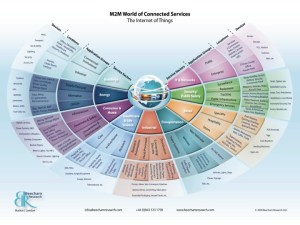 M2M is not a solution. It is a way to segment the market: are we connecting a business, person or a thing to the Internet? The actual connection is of less importance to users – it is what it enables that makes sense. And the data created makes even more sense. We have seen the movie before – when people and business were connected to the Internet we started focusing on the connection. Then we discovered enormous benefits when processes became much more efficient. And finally innovative solutions and business models started change industries upside down. We entered the “as-a-service” era.
Over the last 18 months we have seen a clear change from the 50 billion devices approach to M2M towards a more user oriented approach where a range of M2M solutions are part of the ICT toolbox. If we compare to when Internet arrived we are leaving the connectivity period and enter the enabling user value era. We solve customer problems, we save money, we increase efficiency, we bring cost down or save energy. We create operational value. Previously everyone talked about smart meters and connected vehicles due to the large numbers involved. Now the addressed markets discussed are increasingly granular. The further we go down this road the more critical specialist service enablers become.
Last year the Connected Home pavilion at MWC in Barcelona was an important frequently visited showcase for M2M solutions and M2M was mentioned in most key notes. This year, the Connected City pavilion at MWC was a quite boring and less crowded but in every corner of the show and at every party people discussed what could be done with M2M solutions.
Mobile operators all try to figure out which role to play. Subscriptions alone seem less interesting. Adding device connectivity on top of the network helps deliver a better service. Going after large applications like smart meters, ebooks and connected cars is a no brainer. But how to win and deliver the second and third-tier of opportunities is the thousand dollar question of today. Small business is big business. I am convinced that those who can find a way to collaborate with the specialist service enablers will win. And such collaboration is not a matter of technical integration – it’s all about trust, business models and how to go to market. Our Swedish M2M Service Enablers alliance is always interested in efforts to answer the thousand dollar question of today.
 Leave a Comment » |
  Business Models, M2M, M2M Service Enablers | Tagged: as-a-service, B3CC, B3IT, Business model, connected city, connected home, go-to-market, Internet of Things, M2M, Mobile World Congress, mwc, SMSE |
  Permalink
 Posted by magnusmelander
February 19, 2013
 M2M Service Enablement is the “magic” turning generic communication services into specific applications in an affordable and scalable way. Users need applications addressing their needs and the role of M2M Service Enablers is to make it easier, faster and cheaper to develop, implement and maintain such applications. But M2M Service Enablement is complex and requires communication and IT skills together with serious understanding of the industry or function to serve. Service Enablers need to be specialized since only the companies understanding the context of the data can deliver to the customers according to their expectations. “Connecting things and gather data in the cloud” is already too generic.
The Service Enablement market will be specialized and industry focused. But still it has to become international for M2M to really take off. Today the M2M Device Connectivity part of it is quite international but most Specialist Service Enablers are domestic. And while Device Connectivity solutions enable operators to deliver better and more granular services, Specialist Service Enablers are needed to bring new customers.
In order to try push Service Enablement to become international I started a small alliance called Swedish M2M Service Enablers a year ago. Today two new members joined and we are now ten companies. But we also announced four new sponsors of our initiative, are mobile operators. This gives us more weight and power which is needed to move the internationalization forward.
The purpose of the alliance is to educate the market, promote Sweden as a great place to go to for Service Enablement solutions and to promote the individual members abroad. We welcome invites to collaborate, discuss, speak and most importantly make business together. A number of such relationships are already in place but we can manage many more. Just keep them coming! Next opportunity is to ask for me in the Swedish Pavilion at Mobile World Congress, hall 7 (stand 7E80).
Leave a Comment » | Business Models, Cloud computing, M2M, M2M Service Enablers | Tagged: B3CC, B3IT, Business model, Internet of Things, IoT, M2M, SMSE | Permalink
Posted by magnusmelander
December 27, 2012
 The key to rapid progress and growth in the M2M market is Service Enablement. It is the middle-ware, the magic, between generic connectivity and the specific applications the customers are asking for. The Service Enablement has to be robust, secure and efficient in order to make the solutions affordable to develop and maintain. It is also important for the communication provider’s M2M business to scale nicely. Beyond technical matters Service Enablement also has to cover practical issues like deployment and support.
There are three ways to deploy service enablement: in-house, by mobile operator or by independent service enablers. The in-house option is most often used when the data from the connected devices are business-critical which is typically the case when companies provide their product as services. The independent Service Enablers typically place their services on top of the connectivity and provide the entire customized solution for the customer and the devices connected. And mobile operators are increasingly adding a quite generic piece of Service Enablement on top of their connectivity services, dealing with things like alarms, device management, self-service portals and more granular invoicing. This is often referred to as Device Connectivity services which is a natural way for mobile operators to make their M2M offering richer and more competitive.
The Service Enablement part of the market has developed rapidly over the last year with several operators announcing agreements with primarily Jasper Wireless and Ericsson. But we also have a lot of independent Service Enablers active in the M2M market. These independents are most often small national players with scarce resources and difficulties to reach out. We started Swedish M2M Service Enablers (swedishm2m.se) last spring to join forces educating the market and promoting the members. Today we are eight members in the alliance with more in line. But still the operator offerings are too generic for most customers and the indies don’t have muscles enough why customer uptake remain quite slow.
I believe we have to be more granular when talking about Service Enablement in order to get to a solution which is good enough to develop and maintain specific customer applications on. In Beecham’s most recent SES study they identified 22 different service groups and 112 individual service elements within those so M2M Service Enablement is clearly a complex issue. It is already clear that independent Service Enablers must be at least industry focused. It is simply too easy today to just connect terminals and gather the data in the cloud. A competitive service need to understand the data and what to do with it. In other words, Service Enablers have to become Specialist Service Enablers to survive and that is rapidly happening now. With generic Device Connectivity solutions providing standardized APIs for the Specialist Service Enablers to use, the indies can focus all their resources on their speciality. And the operators with such solution in place would be far more attractive to customers and their software developers and integrators to work with. Provided I am right and the market will develop in this direction it might be a dead-end for operators to develop Device Connectivity in-house.
Leave a Comment » | Business Models, M2M, M2M Service Enablers | Tagged: API, B3CC, B3IT, Business model, Device Connectivity, EDCP, Ericsson, independents, indies, Integrator, Internet of Things, Jasper Wireless, M2M, Machine-to-Machine, magic, SMSE, Software developer, Specialist service enabler | Permalink
Posted by magnusmelander
October 11, 2012
 Services Enablement is the magic that turns generic communication into specific M2M applications and as such absolutely key to a positive development of M2M. In order to educate the market about the importance of Services Enablement and to promote Swedish Services Enablers I initiated Swedish M2M Services Enablers – SMSE – in March 2012. With the most recent additions we are now eight companies in the alliance.
The Mobile Future conference followed by Mobilgalan award dinner is the key mobile industry event in Sweden since many years and includes the most prestigious mobile awards ceremony. Yesterday the organizers of the event, Mobil and Mobil Business, announced nominations to the
Guldmobilen (Golden Mobile) awards 2012. M2M was introduced as a new category for 2012 which underlines the importance of M2M to the mobile industry and progress in market penetration. Four of the five nominated companies in the M2M category are members of the SMSE alliance which clearly communicate the importance of Services Enablement for the M2M market to develop well. This is all very good news and a concrete evidence of progress. Please join me congratulating
Maingate, Kombridge, Info24 and Springworks for their nominations!
Leave a Comment » | M2M, M2M Service Enablers | Tagged: Awards, B3CC, B3IT, Guldmobilen, Info24, Internet of Things, IoT, Kombridge, M2M, Machine-to-Machine, Maingate, Mediaprovider, Mobil, Mobil Business, Mobil Future, Mobilgalan, Services Enablers, SMSE, Springworks | Permalink
Posted by magnusmelander
October 3, 2012
 The magic between the generic communication services and the specific application providing desired value to the users business is what we call M2M Services Enablement. This component of a M2M solution is absolutely vital since it shortens time and effort to develop the solution and minimize the effort to maintain and further develop the solution. The more robust and complete the Services Enablers become, the more users will decide to use M2M solutions. Services can be applied in three different ways: communication providers can add it on top of the connectivity, owners of the connected things can run Services Enablement in-house and one can use an independent third-party.
From a pure technical point of view Services Enablement platforms are generic but the successful providers of these services will be very focused on a specific niche or industry. If we look at a straight forward consumer solution like sleep monitoring, there are several solutions available. But one day there will be a market leader and that solution will definitely include some kind of intelligence applied on the information gathered in the cloud. It could typically be world-class sleep experts who can look at your data and give advice or comparisons to relevant indexes. With such services available it will be difficult to sell a plain stand-alone sleep monitoring solution. What is done with the information collected will differ from industry to industry but the logic will still be the same: players in an industry will benefit from using the Services Enabler who can add most value to their business and they will most likely end up using the same one. Following this logic there will be a large number of Services Enablers each focused on a specific industry, application or niche. The marked development for Services Enablers seems likely to follow Geoffrey Moore’s theories about “crossing the chasm”. Targeting a specific pin in bowling alley is the way to cross the chasm. When on the other side, it’s possible to target another pin, using the first pin as reference.
I continue develop the Swedish M2M Service Enablers (SMSE) alliance and we just included two more companies: Springworks and Episcope. They both follow the logic above and focus on the Automotive industry and Process Industry respectively. I continue to believe that M2M Services Enablement will be a forte for Swedish start-ups.
1 Comment | Cloud computing, M2M, M2M Service Enablers | Tagged: apps, B3CC, B3IT, chasm, crossing the chasm, Episcope, Geoffrey Moore, Internet of Things, M2M, Machine-to-Machine, SMSE, Springworks, Swedish start-ups, Traffic | Permalink
Posted by magnusmelander
March 23, 2012
 A key challenge for the M2M industry right now is to enable time and resource efficient development of specific M2M applications to industries or even companies. As soon as the interesting devices are connected in a proper way, data needs to be collected, organized and combined with other relevant data in order to provide useful information to new or existing applications. Devices need to be monitored, alarms have to be taken care of and maybe even transfer of money needs to be handled. This is what is done in M2M Services Enablement systems – the key to successful M2M deployments.
The Services Enablement systems can be deployed in three different ways: as extensions to operator connectivity offerings, as independent services from a third-party or as an in-house service to support M2M initiatives. It seems obvious that devices in many cases will be connected using a mix of technologies which further complicates this issue. It is my experience that we always end up in different communication technologies for wide area networks, local area networks and personal area networks/short-range communications. And even though wireless most often is preferred when feasible, also fixed networks will be used onwards. Needless to say, it is challenging to build a Services Enabler solution and to choose which solution to use in a specific situation.
We need to make it easier for potential customers to understand and decide which type of solution to use in order to accelerate deployments of real M2M solutions. Six Swedish companies just joined forces under the name of “Swedish M2M Service Enablers” in an ambition to start work together on educating the market on the importance of Services Enablement solutions and to try establish some common language and even APIs. The collaboration is also an attempt to market the companies to customers and partners abroad. Please visit http://www.swedishm2m.se to read more about the initiative or take a look at the press release issued today at http://www.mynewsdesk.com/se/view/pressrelease/swedish-m2m-services-enablers-initiative-launched-to-jointly-promote-swedish-companies-with-world-class-solutions-744720
Leave a Comment » | M2M, Networks | Tagged: B3CC, B3IT, Internet of Things, M2M, Machine-to-Machine, open api, SMSE, Swedish M2M, Swedish M2M Services Enablers | Permalink
Posted by magnusmelander
 M2M is not a solution. It is a way to segment the market: are we connecting a business, person or a thing to the Internet? The actual connection is of less importance to users – it is what it enables that makes sense. And the data created makes even more sense. We have seen the movie before – when people and business were connected to the Internet we started focusing on the connection. Then we discovered enormous benefits when processes became much more efficient. And finally innovative solutions and business models started change industries upside down. We entered the “as-a-service” era.



 connectcompute